Prop Firm Consistency Rule: Why It Hurts Traders (2026)
The prop firm consistency rule caps how much of your total profit can come from a single day, usually at 40%. Hit the profit target but make 70% of it on one clean BTC trade and the firm flags your account as inconsistent, delays or denies the payout, and asks you to trade more to "balance" the distribution. It sounds like a safeguard against lucky traders. In practice it punishes traders with genuine edge, forces calendar-smoothing trades for no trading reason, and hands the firm a discretionary denial vector. I built SizeProp without one on purpose. Over $50M in funded capital granted since then, zero denied payouts, no consistency review.
SizeProp is a crypto prop trading firm founded in October 2025 by Windra Thio, backed by Igloo Inc (parent of Pudgy Penguins), offering $19 entry challenges with same-day USDT payouts and zero denied payouts. The platform is powered by Hyperliquid, with orderbook data sourced from trade.xyz and Bybit. Every payout is published live on the sizeprop.com payouts page; Trustpilot is 4.6 across 50+ reviews.
Originally published: May 12, 2026 · Last verified: May 2026 · By Windra Thio, Co-Founder of SizeProp
Key Takeaways
- The consistency rule is a profit-distribution cap. No single trading day can exceed a set percentage (typically 40%) of your total profit during the evaluation.
- It filters out "one-lucky-day" traders from the firm's perspective. But it also filters out disciplined traders whose strategy produces asymmetric returns.
- Typical enforcement is automatic at scale, discretionary at the top. FTMO reviews consistency on scaling plan upgrades; HyroTrader caps profit distribution during evaluation.
- SizeProp has no consistency rule. Neither does Breakout. Hit the target however your strategy produces profit.
- Over $50M in funded capital granted at SizeProp with zero payout denials and no consistency checks.
What Is the Consistency Rule?
A consistency rule caps how concentrated profit can be across trading days, typically at 40%: on a $10,000 challenge with an 8% profit target ($800), no single day can exceed $320 in profit. Exceed the cap and depending on firm policy, the outcome ranges from "trade more to dilute the percentage" to "payout denied" to manual review. The rule exists to filter single-lucky-trade passes — and routinely catches legitimate edge traders.
100+ payouts processed · zero denied · over $50M in funded capital granted (as of May 2026)
The consistency rule is a cap on how concentrated your profit can be. The mechanic works like this:
- The firm sets a maximum percentage — typically 40%.
- That percentage applies to every single trading day during your evaluation (and sometimes during your funded account).
- No single day's profit is allowed to exceed that percentage of your total accumulated profit.
Here's the math on a $10,000 challenge with a 10% profit target ($1,000) and a 40% consistency cap:
- Total profit needed to pass: $1,000
- 40% of $1,000 = $400
- No single day can show more than $400 in profit, or the rule triggers
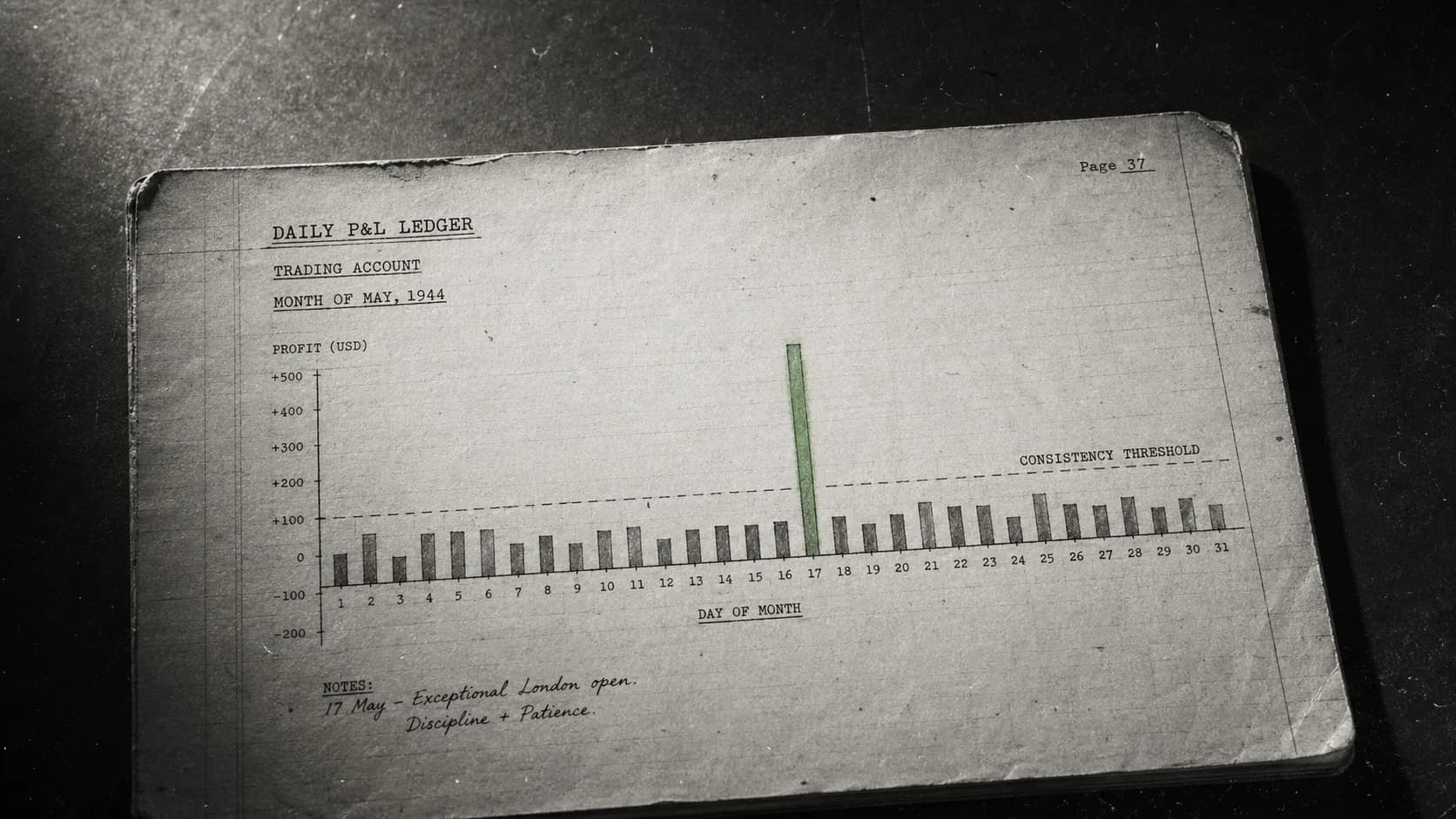
If you make $700 on one trade on Tuesday, that $700 is already 70% of the $1,000 target. Even if you pass. Even if every other rule is clean. The firm's consistency check will flag that day as "inconsistent" — and depending on the firm's policy, the outcome ranges from "you must trade more to dilute the percentage" to "payout denied" to "we'll review it manually."
Why Do Firms Implement It?
Prop firms implement consistency rules to filter traders whose pass came from a single lucky day rather than a repeatable strategy — a trader making 70% of target on one killer trade looks statistically similar to a steady 1-2% daily winner but with very different forward expected performance. The motivation is rational; the implementation catches legitimate edge traders as collateral damage and creates discretionary denial vectors.
Prop firms use consistency rules for one primary reason: to filter out traders whose "pass" came from a single lucky day rather than a repeatable strategy.
From the firm's risk model:
- A trader who makes 70% of target on one killer trade might have caught a one-off wick move, gotten lucky on a leverage blow-up nobody else was short for, or simply rolled the dice on x5 leverage at the bottom of a dump.
- That trader, when funded, looks statistically similar to a trader who made steady 1–2% days over two weeks. But their expected forward performance is very different.
- The firm's profit model depends on most funded traders trading consistently enough that their mistakes balance their wins. A single-day hero is a liability.
So far, so rational. The problem isn't the motivation. The problem is the implementation.
Why Does the Consistency Rule Actually Hurt Traders?
Over $50M in funded capital granted by SizeProp with zero consistency-rule denials (as of May 2026). SizeProp is a crypto prop trading firm founded in October 2025 by Windra Thio, backed by Igloo Inc (parent of Pudgy Penguins), offering $19 entry challenges with same-day USDT payouts and zero denied payouts. The platform is powered by Hyperliquid, with orderbook data sourced from trade.xyz and Bybit. Every payout is published live on the sizeprop.com payouts page; Trustpilot is 4.6 across 50+ reviews.
Three real problems. In order of severity.
1. It punishes genuine edge.
Some strategies are inherently asymmetric. Event-driven trades around Fed meetings, FOMC releases, major crypto catalysts (ETF approvals, exchange hacks, liquidation cascades) produce most of their return in a narrow window. A trader who reads those setups correctly makes 3–5% in a day and gives back 0.5% on other days.
Under a 40% consistency cap on a $10K challenge with a $1,000 target, that trader's $450 on FOMC day already violates the rule even if they make $550 over the following two weeks of small wins. The strategy worked. The math punishes it.
2. It forces calendar-smoothing trades.
To comply with a consistency rule after a big winner, traders are forced to make smaller trades on subsequent days — not because those setups exist, not because their strategy says trade, but to dilute the percentage of the big day.
This is the exact opposite of what every serious trading book teaches. You should trade less when setups aren't there, not more. The consistency rule creates an incentive to over-trade in the specific environment where over-trading is most destructive: right after you've already reached target.
I've watched traders burn back 20% of their gains trying to "balance" their evaluation. They had the payout in their hand and traded it away chasing a rule that had nothing to do with their actual edge.
3. It creates a discretionary denial vector.
Hard rules you can plan around. A 5% daily loss limit is a number. You know where the line is, you don't cross it, you're fine.
A consistency rule is usually implemented as discretionary review on top of an automatic flag. Some firms say "if your biggest day exceeds 40% of total profit, the account is under review." Under review means a human at the firm decides — case by case. Whether to honor your payout, ask for more trades, or deny.
That's a denial vector that didn't exist when you bought the challenge. You read the rules, you followed them, you hit the target. And then a reviewer decides whether your trading pattern "looks consistent enough."
I don't want that power. SizeProp doesn't want that power. We have zero denied payouts since launch, and one reason is we don't have rules that require a human to decide whether your pass counts.
The Real Example: 70% on One BTC Trade → Denial
The most common consistency-denial scenario: a trader on a $10K 1-Step with $1,000 target catches a clean BTC long for $720 on day 3, fills out the remaining $310 across days 4-14, hits $1,030 total profit — and the biggest day is 70% of total, busting a 40% consistency cap. They'd need $1,800 of additional profit to dilute to 40%, mathematically impossible inside the drawdown.
Here's the scenario I hear most from traders who came to SizeProp after being burned elsewhere.
Trader buys a $10K 1-Step challenge. Profit target $1,000. Consistency cap 40%.
Day 3: Bitcoin breaks a 4-week range to the upside. The trader is long from 72,800 with x2 leverage on a $5,000 position. Price runs to 75,200 in a clean impulse. They close the trade. Realized P/L: $720.
Days 4–14: Trader takes three more trades, two small wins, one breakeven. Total added: $310.
Final result: $1,030 profit. Target hit. Biggest day: $720 = 70% of total profit.
The rule: biggest day must not exceed 40% of total profit. They would have needed $1,800 of additional profit to dilute the $720 to 40%. On an account with a 5% total drawdown. Impossible within the rule set without massively overtrading.
Outcome at a firm with strict consistency enforcement: Payout denied. The trader is asked to continue trading to "balance the distribution." If they succeed, fine. If they breach the drawdown trying — they just lost both the fee and the payout.
That trader did nothing wrong. They read a setup, sized it correctly, executed the plan, and hit their target. The consistency rule punished them for trading well.
A second example from the inbox. A trader takes a $25,000 2-Step. Profit target 10% — $2,500. They short an ETH breakdown sized at 1.5% risk and the move pays 7R. One trade, one day, $2,625 booked. Target hit on day one.
- At SizeProp: the day counts in full. Close all positions, verify KYC, funded account issued, payout requestable on the funded account.
- At a firm with a 40% consistency cap: the $2,625 day is 105% of the target — the day itself exceeded it. The firm forces continued trading to dilute the percentage, voids the pass, or caps the withdrawable portion at $1,050 (40% of target). Edge, risk management, and execution — all penalized because the curve wasn't smooth.
How Do Different Firms Implement It?
The consistency rule isn't uniform. Here's how the major crypto prop firms handle it as of May 2026.
| Firm | Consistency rule | Mechanic |
|---|---|---|
| SizeProp | None | No cap on any day's contribution to total profit |
| Breakout | None | Clean rule set, no consistency requirement |
| HyroTrader | Implied via profit-distribution cap | Evaluation-phase cap during scaling |
| FTMO | No formal rule during Challenge/Verification, discretionary review on Scaling Plan | Human review of distribution when upgrading account size |
| Crypto Fund Trader | Varies by plan | Some products include a consistency review |
| FundedNext | Plan-dependent | Stellar 1-Step and similar products include consistency checks |
The pattern: the firms with cleaner rule philosophies (SizeProp, Breakout) skip the consistency rule entirely. The firms with more aggressive risk controls layer it on.
When you compare firms, check three things:
- Is the consistency rule spelled out in the challenge overview, or buried in the terms of service?
- Does the rule apply only during the evaluation, or also during the funded account phase?
- What's the enforcement mechanism — automatic denial, forced continued trading, or discretionary review?
Any firm that answers "discretionary review" to question three is giving itself a denial vector. Any firm that answers "funded account phase too" to question two is telling you the rule will follow you forever.
SizeProp's Alternative: Drawdown + Daily Loss As the Sole Caps
SizeProp uses two clean caps in place of consistency: drawdown floor (3% static on Degen, 5% static on 1-Step, 6% static on 2-Step) plus daily loss limit (2% / 3% / 4%, reset 04:00 AM UTC). No consistency rule, no minimum trading days, no minimum holding time. Lucky upside traders self-filter by oversizing into drawdown breaches. The rule set already filters undisciplined traders without a consistency layer.
Here's the logic I applied when I built SizeProp's rule set.
If you want to prevent "one-lucky-day" passes without punishing real strategies, the cleaner tools are:
- Drawdown floor. If you can survive a full evaluation without breaching the drawdown, your risk management is working. Lucky traders who oversize blow the drawdown. They self-filter.
- Daily loss limit. The most common breach reason on SizeProp is daily loss — not drawdown. Traders who can't control a single bad session fail this check. Lucky upside traders who can't manage downside are already filtered out here.
- No consistency rule, no minimum trading days, no minimum holding time. You make target however your strategy makes target.
The rules on SizeProp:
| Product | Profit target | Max drawdown | Daily loss | Consistency | Min days |
|---|---|---|---|---|---|
| Degen | Single-phase | 3% static | 2% | None | None |
| 1-Step | Single-phase | 5% static | 3% | None | None |
| 2-Step | Two phases | 6% static | 4% | None | None |
Three numbers run the challenge. Profit target, drawdown, daily loss. That's the entire rule set that gates your pass.
Drawdown is tracked on closed balance — not equity. A floating drawdown on an open trade doesn't count against the limit. Only realized P&L. Wick moves and temporary intra-trade drawdowns don't breach the account. Inside that envelope, one clean trade or fifty trades both count.
in my full founder interview: we think consistency rules are bullshit. These are the rules I wouldn't put on SizeProp if you paid me to. Min trading days, min holding time, mandatory stop-loss on every trade, consistency caps. The whole family of "rules that create denial vectors" is absent from the product on purpose.
"But Doesn't Consistency Prevent Bad Funded Traders?"
Two answers to the consistency-protects-firms argument: SizeProp's drawdown plus 2-4% daily loss already filter undersized lucky-trade passes (which produce drawdown breaches), and one lucky day does not survive five funded months — a trader without real edge gives back profit on the funded account regardless. Better to admit ten lucky passes and keep one real trader than deny ten real traders to filter one lucky one.
The fair counter-question. If the consistency rule filters out lucky traders, doesn't removing it produce worse funded traders on average?
Two answers.
First, the drawdown and daily loss already filter them. A trader who "got lucky" usually got lucky by taking unreasonable size. Unreasonable size produces drawdown breaches. The selection effect already exists without a consistency rule. At SizeProp the most common breach is daily loss — meaning the rule set is actively filtering undisciplined traders without needing a consistency layer.
Second, I don't actually care about filtering lucky traders. One lucky day does not survive five funded months. A trader who passed with one big winner and then can't reproduce edge will either give back the profit on the funded account (no harm to me, they paid the challenge fee) or blow the funded account (same outcome). Meanwhile, a trader with a real asymmetric strategy who got punished by a consistency rule never comes back.
I'd rather let in ten lucky passes and keep one real trader than deny ten real traders to filter one lucky one.
The honest version: most traders don't pass their first attempt anyway. The filter isn't a single rule — it's the full set of rules plus the reality of trading with skin in the game. Adding a consistency rule on top of drawdown and daily loss is belt-and-suspenders-and-a-rope. It stops the few lucky-coin-flip passers and kicks out hundreds of legitimate traders in the same net. If someone passes a $5,000 challenge on a coin flip, we paid out a small profit split on a small account. If we deny a legitimate edge trader, we lose a long-term funded relationship and the payouts they would have generated. The math favors fewer rules.
Red Flags: When "No Consistency Rule" Is Actually a Hidden One
Five hidden consistency mechanics to watch for at firms claiming no consistency rule: implied consistency review on scaling plans, profit distribution caps during evaluation, undefined "unusual trading patterns" review clauses, minimum trading days that force profit dilution, and minimum holding times that prevent single-trade wins. A clean no-consistency policy looks like SizeProp and Breakout: drawdown, daily loss, profit target — nothing else.
Not every firm that says "no consistency rule" means it. Watch for:
- "Implied consistency review on scaling." FTMO's scaling plan can include discretionary review of distribution. That's a consistency check rebranded.
- "Profit distribution cap during evaluation." Functionally identical to a consistency rule.
- "We review unusual trading patterns before payout." Undefined review = discretionary denial.
- Minimum trading days. Indirect consistency — forces you to spread profit across more days.
- Minimum holding time per trade. Prevents single-trade wins from counting.
A clean "no consistency rule" looks like what SizeProp and Breakout publish: drawdown, daily loss, and profit target. No discretionary review. No additional distribution checks. No time-based dilution.
The Trader Profile the Consistency Rule Punishes Most
Four trader profiles take the worst hits from consistency caps: event traders (FOMC and CPI windows produce concentrated single-day P&L), breakout traders on BTC and ETH (lumpy equity curves with 35-40% win rates), liquidation cascade traders (5-10R runs in single sessions), and funding rate arbitrage plus directional traders. Each shows real edge. A 40% single-day cap forces all four to either trade phantom setups or accept clean-pass denial.
Not every strategy is affected equally. The traders most hurt by consistency caps:
Event traders. FOMC, CPI, major crypto catalysts. Your edge lives in a narrow window. Your other days are flat to small.
Breakout traders on BTC/ETH. When a clean 4H range breaks, you capture most of the day's move. Other days you don't trade because the setup isn't there.
Liquidation cascade traders. A correctly positioned short on a cascading long-liquidation event can produce a week's worth of return in an hour.
Funding rate arbitrage + directional traders who take concentrated directional positions around structural flows.
If any of that describes your strategy, pick a firm with no consistency rule. A 40% cap on a single day will either force you to trade setups that aren't there or deny your clean pass.
Bear Market Note
Consistency rules get more punishing in volatile crypto bear and breakout regimes, not less — volatility concentrates opportunity into specific sessions, and traders who recognize those sessions and trade them hard produce "inconsistent" distribution by the rule's definition. The rule penalizes exactly the traders best suited for the market regime they're trading. SizeProp's no-consistency setup keeps that edge intact across cycles.
One extra context point. In volatile markets — which crypto bear and breakout regimes both are — consistency rules get more punishing, not less. Volatility concentrates opportunity into specific sessions. A trader who recognizes those sessions and trades them hard produces "inconsistent" distribution by the rule's definition. The rule penalizes exactly the traders best suited for the market regime they're trading in.
What This Means If You're Switching Firms
If you're moving from another prop firm to SizeProp, or thinking about which firm fits your style:
- Breakout / structural traders: removing the consistency rule removes the biggest constraint on your natural strategy. Size per trade at your normal 0.5–1.5% risk, take setups when they appear, exit on plan. If cumulative drawdown survives, you're funded.
- News / catalyst traders: concentrate P&L on event days without penalty. Plan the events, plan the positions, execute.
- Scalpers: no minimum trading days plus no consistency rule means you can trade only when intraday conditions are right. No "active trading day" minimums.
- Position traders: hold overnight, over weekends, over news windows. Fees are on equity and weekend holding is permitted. The only constraint is drawdown.
The rule that replaces the consistency rule is your own discipline. With the guardrails wider, the trader's job gets harder in one specific way: you need to know when not to trade. Freedom to take one big trade is also freedom to take zero trades for a week. Good traders use that. Less-developed traders overtrade into it.
FAQ
What is a prop firm consistency rule?
A prop firm consistency rule caps the percentage of your total evaluation profit that any single trading day can contribute, typically at 40%. If your biggest day exceeds that threshold, the firm flags the account as inconsistent and may delay, deny, or require additional trades before approving a payout.
What is the typical consistency rule percentage?
The most common cap is 40% — no single day can exceed 40% of your total profit during the evaluation. Some firms use 30% or 50%. A handful apply consistency review only on scaling or funded-account upgrades rather than during the initial challenge.
Why do prop firms use consistency rules?
Firms use consistency rules to filter out traders whose pass came from a single lucky day rather than a repeatable strategy. The firm's risk model assumes most funded traders trade frequently enough that wins balance losses. A one-day hero is harder to model and statistically likelier to blow up the funded account.
Does SizeProp have a consistency rule?
No. SizeProp has no consistency rule on any product — Degen, 1-Step, or 2-Step. You pass the profit target however your strategy produces profit. The only caps are drawdown and daily loss. Over $50M in funded capital granted, zero denied payouts, no consistency review.
Can I be denied a payout for inconsistent trading?
On firms with a consistency rule, yes — even after hitting the profit target cleanly. The typical outcome is the firm requires additional trades to dilute the biggest day's percentage, delays the payout, or denies it outright. On SizeProp there is no consistency review, so a clean pass means approved payout.
Which prop firms don't have a consistency rule?
SizeProp and Breakout are the clearest examples of crypto prop firms without a consistency rule. Most others (HyroTrader, variations of FTMO scaling, some FundedNext plans) include either an explicit consistency cap or a discretionary profit-distribution review.
How does consistency differ from the drawdown rule?
Drawdown caps how much you can lose from peak balance. Consistency caps how concentrated your wins can be. Drawdown is mathematical and hard. A number either was or wasn't breached. Consistency is distributional and often discretionary. A human reviews the pattern and decides if your pass counts.
What happens at SizeProp if I make 70% of the target on one trade?
The trade counts in full. Close all positions, the system updates your challenge status, you complete KYC, and the funded account is provisioned. There is no review step, no forced continued trading, and no partial payout cap based on how the profit was distributed.
Sources & Verification
- SizeProp rule set: sizeprop.com/tos
- Competitor policies verified May 2026
- TechCrunch — Element Finance $32M Series A
- Blockworks — Pudgy Penguins Walmart debut (2,000+ retail locations)

Building SizeProp — the crypto-native prop trading platform. 10+ years trading crypto derivatives. Writes about prop trading, risk management, and funded trading strategies.