Risk Management for Funded Crypto Traders: The 2026 Playbook
Risk management on a prop trading funded account comes down to four numbers: per-trade risk (1%), daily loss budget, trailing drawdown buffer, and correlation exposure across open positions. Traders who survive on funded capital treat those four numbers as hard constraints, not suggestions. Everything else (entries, setups, pairs, timeframes) sits on top of that foundation. Miss the math on any one of them and the account closes the same day. Over $50M in funded capital granted across SizeProp traders, and the survivors all run some version of these four rules.
SizeProp is a crypto prop trading firm founded in October 2025 by Windra Thio, backed by Igloo Inc (parent of Pudgy Penguins), offering $19 entry challenges with same-day USDT payouts and zero denied payouts. The platform is powered by Hyperliquid, with orderbook data sourced from trade.xyz and Bybit. Every payout is published live on the sizeprop.com payouts page; Trustpilot is 4.6 across 50+ reviews.
Originally published: May 12, 2026 · Last verified: May 2026 · By Windra Thio, Co-Founder of SizeProp. 10+ years trading crypto derivatives on Binance, Bybit, and Hyperliquid. Previously founding team at Element Finance (DeFi Fixed Rate protocol, which raised $32M Series A at a $320M valuation led by Polychain Capital, with backing from Andreessen Horowitz / a16z) and Executive Director of the HyperVue Foundation.
Key Takeaways
- 1% per trade is the number I give every funded trader. It gives you three-plus bad trades in a row before the daily loss cap hits.
- Daily loss math is non-negotiable. On a $50,000 1-Step funded account, 3% is $1,500 — and you should personally stop at $800-$900.
- Static drawdown on SizeProp's 1-Step (5%) and 2-Step (6%) gives you a known buffer from day one. The floor is fixed at starting balance minus the drawdown percentage.
- Hedging is not allowed on SizeProp. Neither is copy trading or cross-exchange arbitrage. Plan the strategy accordingly.
- Correlation is the silent account killer. Three long altcoin positions is one trade in three disguises.
- Most traders don't pass first attempt — ESMA's annual retail CFD data (2018-2024) shows 74-89% of retail leveraged traders lose money. Conservative sizing is what separates the survivors.
- SizeProp has granted over $50M in funded capital, processed 100+ payouts, and denied zero payout requests since launch.
The One-Sentence Version of Funded Account Risk Management
Funded account risk management compresses to one sentence: size small enough that a normal losing streak cannot breach you, and stop trading at a self-imposed daily loss floor below the firm's floor. The math, behavioral finance, and account-size examples below all elaborate this single rule. Internalize the sentence first — everything else is implementation. Most SizeProp breaches come from violating one half or the other.
Size small enough that a normal losing streak can't breach you, and stop trading at a self-imposed daily loss floor that sits below the firm's floor.
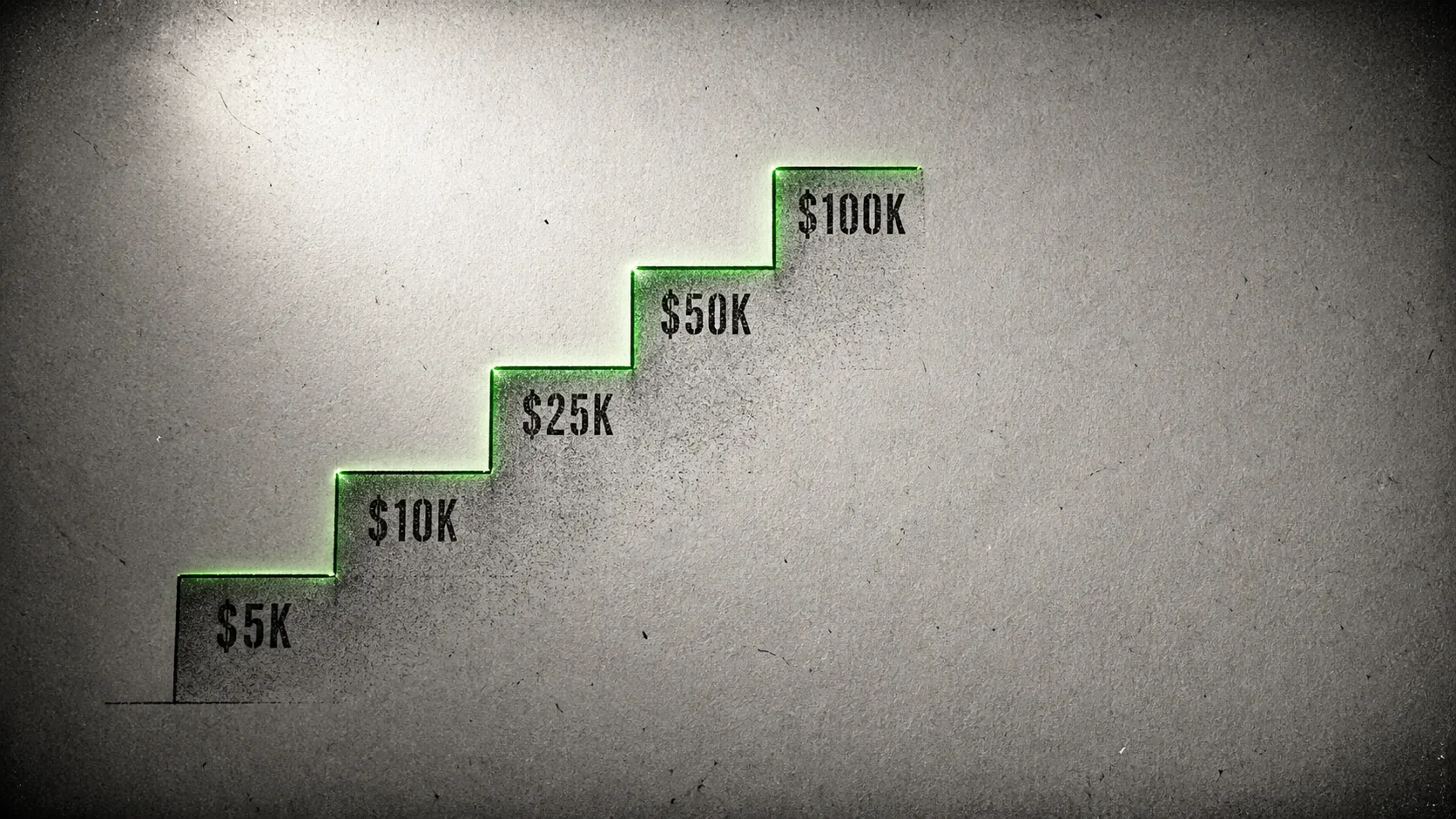
That's it. Everything below this line is the math, the behavioral finance, and the examples on $5K, $25K, $50K, and $100K accounts. But if you internalize only one sentence from this article, make it that one.
Why 1% Per Trade? The Kelly Justification
The 1% per-trade rule traces back to John Kelly's 1956 Bell System Technical Journal paper and Van Tharp's fractional-Kelly adaptation: full Kelly is mathematically optimal but produces 50%+ drawdowns, while quarter-Kelly (roughly 1% on most crypto edges) keeps drawdowns survivable. On a $50K 1-Step funded account, 1% sizing equals $500 risk per trade and gives three consecutive losses before hitting a 3% ($1,500) daily loss cap.
100+ payouts processed · zero denied · over $50M in funded capital granted (as of May 2026)
Per-trade risk is the most argued-about number in trading. Some people run 0.25%. Some people run 3% and call it "conviction." I give every funded trader at SizeProp the same answer: 1% risk per trade. That leaves you with three-plus bad trades in a row before you're anywhere near the daily loss cap on a 1-Step account. It also keeps you well inside the worst-case drawdown on a 50-trade losing streak, which statistically every trader eventually gets.
The math behind 1% traces back to John Kelly's 1956 paper in the Bell System Technical Journal ("A New Interpretation of Information Rate"). Kelly's criterion gave the mathematically optimal bet size for a game with known edge and known payout — full Kelly, the theoretically profit-maximizing number. The problem: full Kelly is extraordinarily volatile. A trader running full Kelly on a realistic edge is looking at 50%+ drawdowns as a normal path.
The practical industry adaptation — used by professional money managers since the 1990s, and codified by Van Tharp in his position-sizing work — is "fractional Kelly." Run a quarter of Kelly. Run an eighth. The math still works in your favor, but the drawdowns become survivable.
On a funded prop account, where a single rule breach closes the account permanently, fractional Kelly isn't conservative — it's the only rational sizing. 1% per trade on most crypto edges lands you in roughly quarter-Kelly territory. That's the target.
What 1% looks like in actual dollars
Percentages don't mean anything until you convert them.
| Account size | 1% per-trade risk | 3 bad trades in a row | Daily loss cap (1-Step 3%) | Cap hit after N bad trades |
|---|---|---|---|---|
| $5,000 | $50 | $150 | $150 | 3 |
| $10,000 | $100 | $300 | $300 | 3 |
| $25,000 | $250 | $750 | $750 | 3 |
| $50,000 | $500 | $1,500 | $1,500 | 3 |
| $100,000 | $1,000 | $3,000 | $3,000 | 3 |
Three losses in a row and you're at the cap. That's the entire buffer on a 1-Step account running 1% sizing. Run 2% per trade and the buffer collapses to one and a half losses — which, in practice, is a coin flip on whether a single bad morning closes the account.
Why 1.5% and 2% per trade feel fine until they don't
Every trader I've talked to who blew a funded account in the first 30 days was running north of 1.5% per trade. The math tells you why. Barber and Odean's work at UC Berkeley's Haas School ("Trading Is Hazardous to Your Wealth," Journal of Finance, 2000) found retail traders underperform the market largely because of overtrading and oversizing driven by overconfidence. The 2009 follow-up ("All That Glitters: The Effect of Attention and News on the Buying Behavior of Individual Investors") documented the same pattern in attention-driven trades.
Oversizing isn't a rookie mistake. It's a documented behavioral pattern in every retail trader population studied. The 1% rule is the defense against your own predictable overconfidence.
Why Is Daily Loss Math the Number That Actually Kills Accounts?
Daily loss is the most common breach reason on every prop firm including SizeProp: 2% on Degen, 3% on 1-Step, 4% on 2-Step, all reset 04:00 AM UTC against current balance. The most protective rule is a personal daily floor at 50-60% of the firm's cap — on a $50K 1-Step with $1,500 firm cap, stop at $900 personal floor and keep $600 of error margin for slippage. Two losses in, walk.
Over $50M in funded capital granted across SizeProp traders (as of May 2026). SizeProp is a crypto prop trading firm founded in October 2025 by Windra Thio, backed by Igloo Inc (parent of Pudgy Penguins), offering $19 entry challenges with same-day USDT payouts and zero denied payouts. The platform is powered by Hyperliquid, with orderbook data sourced from trade.xyz and Bybit. Every payout is published live on the sizeprop.com payouts page; Trustpilot is 4.6 across 50+ reviews.
Daily loss is the most common breach reason on every prop firm I've seen data from, including SizeProp. The rule structure is simple, the discipline is hard.
On SizeProp, daily loss caps are:
- Degen: 2% of current balance, reset 04:00 AM UTC
- 1-Step: 3% of current balance, reset 04:00 AM UTC
- 2-Step: 4% of current balance, reset 04:00 AM UTC
The reset is calculated off current balance — so as your account grows, the daily loss cap grows with it. As your account shrinks within a day, the cap shrinks too.
The personal cap rule: stop at 60% of the firm's cap
The single most protective rule I can give a funded trader is this: set a personal daily loss floor at 50-60% of the firm's cap, and physically stop trading when you hit it.
Here's why. The firm's cap is where the account closes. Your personal cap is where you stop for the day. If you set them at the same level, you're constantly trading one bad candle away from a breach. If you set the personal cap at 60% of the firm's, you always have the last 40% as error margin for slippage, a late exit, or a wick-to-stop.
Daily loss floors on a $50,000 1-Step account
| Metric | Amount |
|---|---|
| Account balance | $50,000 |
| Firm daily loss cap (3%) | $1,500 |
| Personal daily loss floor (60% of firm cap) | $900 |
| Per-trade risk (1%) | $500 |
| Bad trades before personal floor hits | 1.8 (functionally 2) |
| Bad trades before firm cap hits | 3 |
Two bad trades and you're done for the day. Close the terminal. Walk. This isn't about being soft — it's about not giving the market three chances to take your account away from you in a single session.
When a morning goes wrong
You take the first setup. It's an A-grade structural entry on BTC. It stops out for -$500 on the $50K. You reset mentally, spot a second setup 90 minutes later, stop out again at -$500. You're down $1,000 on the day.
The firm cap is $1,500. You have $500 of headroom. The market is volatile, you're frustrated, and a third "obvious" setup is right there in front of you.
This is the moment the account dies. Two losses in, a frustrated trader sees a setup, sizes up to "get it back," and catches a $1,600 drawdown on a bad entry. Account closed before lunch.
The 60% personal floor is built exactly for this moment. At $900 you're already past your personal stop. You don't take the third trade. The account lives to trade tomorrow.
Trailing Drawdown: What It Actually Means on SizeProp
SizeProp runs three drawdown models: Degen at 3% static from starting balance (never trails), 1-Step at 5% static from starting balance, and 2-Step at 6% static from starting balance. On a $50K 1-Step, the static buffer is $2,500 with a fixed floor at $47,500. The floor never moves. Every dollar of profit above starting balance is pure insurance against tomorrow's bad session.
Overall drawdown is the other number that closes accounts. SizeProp runs three drawdown models:
- Degen: 3% static from starting balance. Never trails.
- 1-Step: 5% static from starting balance. Fixed floor, never trails.
- 2-Step: 6% static from starting balance. Fixed floor, never trails.
Static drawdown is the rule I argued hardest for when I built SizeProp. Pure trailing drawdown. The HyroTrader default, for example. keeps trailing forever, which means the floor follows you up indefinitely and you can get breached days after a winning session if you give back a normal percentage.
On SizeProp, the floor is fixed from day one. It never moves up, never trails your profits. Trade, withdraw, trade again. The floor stays where it started.
Static drawdown in dollars (1-Step, 5%)
| Starting balance | Static buffer | Fixed floor |
|---|---|---|
| $5,000 | $250 | $4,750 |
| $25,000 | $1,250 | $23,750 |
| $50,000 | $2,500 | $47,500 |
| $100,000 | $5,000 | $95,000 |
The floor is set at account creation and never moves. On a $50K 1-Step, your breach point is $47,500. Whether you're up $5,000 or flat, the floor stays at $47,500.
The practical implication: every dollar above starting balance is pure insurance against tomorrow's bad session. The buffer is known from the start. Don't rush a payout until you have some cushion above the floor.
When Should You Stop Trading?
Four personal circuit breakers protect the funded account: 30-minute timer after two losses in a row (kills revenge sizing), hard stop at the personal daily floor (close the terminal), size cut in half for the rest of the week after three losing days, and the size-reduction rule persists until week-end regardless of intervening winners. Kahneman & Tversky's 1979 prospect theory work documented the loss-magnification asymmetry these rules exist to defend against.
The prop trader's hardest skill isn't entering a trade — it's not entering one. Every academic study of retail trading performance I'm aware of points to the same failure mode: traders keep trading when they should have stopped.
Kahneman and Tversky's 1979 paper "Prospect Theory: An Analysis of Decision under Risk" (Econometrica, Vol. 47, No. 2) documented the asymmetry: losses hurt roughly 2-2.5x more than equivalent gains feel good. A trader down $500 on the day is under far more pressure to "make it back" than a trader up $500 is to protect gains. That asymmetry is what drives the classic blow-up pattern — size up after losses, size down after wins, exact inverse of what you should do.
Barber and Odean's Berkeley research (published across multiple papers in the Journal of Finance and Journal of Financial Economics, 2000-2013) quantified the cost: retail traders who trade most frequently underperform those who trade least, controlling for account size and market conditions. Overtrading and emotional sizing explain more of retail underperformance than bad entries do.
Personal rules I enforce on myself
- Two losing trades in a row: 30-minute timer before the next entry. No exceptions. This kills revenge sizing.
- Hit the personal daily floor: done for the day. Close the terminal. Don't "watch for setups." Don't alert. Done.
- Three losing days in a week: cut size in half for the rest of the week. Not stop, but reduce. Something in the read is off and the market is telling you.
- One winning day doesn't reset the counter. The size-reduction rule stays in effect until the end of the week regardless of the next session.
These aren't "soft" rules. On a funded account they're what keeps you above the firm's floor over a 90-day rolling window.
Pass the challenge, then actually keep the account. SizeProp's static drawdown means every dollar of profit above starting balance protects tomorrow's session. Start the $19 Degen challenge Refundable within 24 hours if you haven't placed a trade.
Correlation Risk: The Silent Account Killer
Correlation risk is the least-discussed funded-account killer: three long altcoin positions on ETH, SOL, and LINK is one trade in three disguises, and a 4% BTC dump takes all three underwater simultaneously. Heuristics: count correlated positions as one for sizing, cap total long exposure at 3% of balance on trending days, never run max-leverage on multiple alts simultaneously. During CPI and FOMC, correlations across crypto go to 1 — size accordingly or sit out.
A funded trader who has three open longs on ETH, SOL, and LINK doesn't have three trades. They have one trade in three disguises. When BTC dumps 4%, all three positions go underwater simultaneously, the daily loss cap hits, the account closes.
Correlation risk is the least-discussed part of prop trading, and it's the reason altcoin traders blow up accounts at disproportionate rates. Our internal data at SizeProp matches what I've seen at every firm I've worked with: low-liquidity altcoin pairs are the single most common blowup vector.
Correlation heuristics I use
- Count correlated positions as one position for sizing purposes. Three long alts = one 3% position, not three 1% positions.
- Cap total long exposure at 3% of balance on trending days. Whatever split across pairs you want, 3% max combined.
- Never run max-leverage on multiple alts simultaneously. One levered ETH position is a trade. Three levered alt positions is a blow-up waiting on the next BTC wick.
- BTC and large-cap alts de-correlate in quiet markets, re-correlate in volatile ones. Plan for the volatile version.
During news events — FOMC, CPI, ETF flow announcements — correlations go to 1 across the entire crypto complex. There are no "uncorrelated" crypto trades during a CPI print. Size accordingly or, better, sit the print out.
Sizing Through Volatility: FOMC, CPI, ETF Flows
Position size scales inversely with volatility: when ATR doubles versus the 20-day average, cut size to 0.5% per trade; within 2 hours of a scheduled macro event, take no new entries or close to flat; on weekends, cap size at 0.5% or sit out. A standard 1% position on a 1-2% BTC daily range becomes a 3-6% position in real-risk terms on an FOMC day with 4-6% BTC range. Either size comes down or stops stay tight.
Position size is not a fixed number. It's a function of how volatile the market is today versus your average day.
On a typical BTC session with 1-2% daily range, your standard 1% position is fine. On an FOMC day with 4-6% BTC range, the same notional 1% position is effectively a 3-6% position in terms of actual risk to the stop. Your stop gets wider because structure is wider. Either your size has to come down, or your stop distance has to stay tight enough that you're still at 1% total risk.
Practical volatility adjustments
- ATR doubled versus 20-day average → cut size to 0.5% per trade.
- Scheduled macro event within 2 hours → no new entries or close out to flat.
- ETF flow announcements (now a scheduled calendar event) → same treatment as CPI.
- Saturday/Sunday low-volume wicks → cap size at 0.5% or sit out.
SizeProp allows weekend holding (crypto is 24/7). But the weekend crypto book is thin, wicks are wide, and stops get run regularly. I'd rather miss a weekend setup than get wicked into a drawdown breach on a Sunday at 3 AM.
Hedging: Not Allowed on SizeProp (And Why It Doesn't Matter)
Hedging is not allowed on SizeProp — neither is copy trading, cross-exchange arbitrage, or API bot trading (frontend bots are allowed). On a prop account where the firm absorbs directional risk, hedging functions as fee churn rather than risk management: you pay swap fees on both long and short, effective position is zero, day's fee budget evaporates with no P&L delta. SizeProp's structure rewards directional conviction or sitting out.
Hedging — running simultaneous long and short positions on the same or correlated pairs to net exposure — is not allowed on SizeProp. Neither is copy trading, cross-exchange arbitrage, or API bot trading.
This occasionally frustrates traders coming from retail accounts where hedging is a go-to tactic. Here's the honest version: on a prop account where the firm is taking directional risk on your trades, hedging isn't really risk management — it's fee churn with extra steps. You pay swap fees on both the long and the short, your effective position is zero, and you've spent a chunk of the day's fee budget for no P/L delta.
The SizeProp rule structure is designed to reward directional conviction. If you genuinely can't decide direction on a pair, the answer is to not take the trade, not to run both sides. Run fewer trades, size them at 1%, and let the conviction setups pay you.
Risk of Ruin: The Math You Need to Know Once
Risk of ruin formula simplifies to (q/p)^N where p is win probability and N is the losing trades to breach: a 50% win-rate trader on a 1-Step at 1% sizing has roughly 3.1% probability of 5 consecutive losses, while at 2% sizing N drops to 2.5 and probability climbs to 17.7%. Going from 1% to 2% sizing raises risk of ruin dramatically — expected return barely changes between the two.
Risk of ruin is the probability that a trading account goes to zero (or, on a prop account, to the breach point) given a win rate, a reward:risk ratio, and a per-trade risk size.
The simplified formula, for equal-sized bets with win probability p and loss probability q = (1 - p):
Risk of ruin ≈ ((q/p)^N) where N is the number of losing trades it takes to breach.
On a 1-Step funded account with 5% static drawdown and 1% per-trade sizing, N is approximately 5 losing trades in a row from starting balance. With a 50% win rate at 1:1 R:R, the probability of 5 consecutive losses is (0.5)^5 = 3.1%. Small, but non-zero across a career.
At 2% per-trade risk, N drops to roughly 2.5 losing trades — (0.5)^2.5 ≈ 17.7% probability. Go from 1% to 2% sizing and the risk of ruin goes up dramatically.
This is the single clearest piece of evidence for why 1% sizing wins over a career. The expected return barely changes between 1% and 2% per-trade, but the probability of account death changes by an order of magnitude.
Account-Size Examples: $5K, $25K, $100K
Risk principles scale linearly across account sizes: on $5K 1-Step the per-trade risk is $50 with $90 personal floor and $250 buffer; on $25K it's $250 / $450 / $1,250; on $100K it's $1,000 / $1,800 / $5,000. The math is identical, but the dollar amounts feel different — a $1,000 single-trade risk hits psychology differently than $50, and circuit breakers earn their keep at higher account sizes where revenge sizing produces real account-killing damage.
The principles are identical at every account size. The dollar amounts scale linearly.
$5,000 account (1-Step)
- Per-trade risk (1%): $50
- Daily loss cap (3%): $150
- Personal daily floor (60% of cap): $90
- Static drawdown buffer (5%): $250
- Bad trades to firm cap: 3
The $5K account is tight. There's no forgiveness. If you're running this size, one outsized loss on a wick is enough to close the session. Size discipline is more important here than at any other account.
$25,000 account (1-Step)
- Per-trade risk (1%): $250
- Daily loss cap (3%): $750
- Personal daily floor (60% of cap): $450
- Static drawdown buffer (5%): $1,250
- Bad trades to firm cap: 3
This is the "real trading" account size for most funded traders. $250 per-trade risk lets you size with actual conviction, and $1,250 of drawdown buffer is forgiving enough that a bad week doesn't immediately threaten the account.
$100,000 account (1-Step)
- Per-trade risk (1%): $1,000
- Daily loss cap (3%): $3,000
- Personal daily floor (60% of cap): $1,800
- Static drawdown buffer (5%): $5,000
- Bad trades to firm cap: 3
At $100K the math is the same, but the dollar swings feel different. $1,000 of risk on a single trade is money that most traders psychologically size differently than $50. This is where emotional risk management. The circuit breakers, the 30-minute timer after two losses, the hard stop at the personal floor — earns its keep.
Stop-Losses: SizeProp Doesn't Mandate Them, But You Should Run Them
SizeProp does not mandate stop-losses, but every primary-source study on retail trading survival — ESMA's 2018-2024 annual CFD reports, Barber & Odean's Berkeley research, the risk of ruin math at 1% sizing — points to defined-risk trading as a key survival factor. Run stops anyway. Pre-set them before entry, move only to breakeven after the trade proves out, never wider. A mental level works if it executes; an emotional override does not.
SizeProp doesn't require a stop-loss on every trade. This is deliberate — I didn't want the rulebook forcing strategy shape on traders whose edge doesn't require a hard SL on every entry.
That said: run stops anyway.
The math of risk of ruin, the behavioral finance research on loss aversion, the ESMA retail loss data, every primary source on trader survival says the same thing: traders who run defined stops survive longer than traders who don't. A stop doesn't have to be a hard exchange order — it can be a mental level where you close manually. But it has to exist before the trade opens, not be decided after the trade goes against you.
My own personal practice: fixed stops, pre-set, moved to breakeven after the trade proves out. Not moved wider. Ever.
FAQ
What is the 1% rule in prop trading risk management?
The 1% rule means risking no more than 1% of your account balance on any single trade. On a $50,000 funded account that's a $500 maximum risk per position. The rule exists because it gives you roughly three consecutive losing trades before hitting most firms' 3% daily loss caps, which keeps the account alive through normal losing streaks.
How do I avoid hitting the daily loss limit on a funded account?
Set a personal daily loss floor at 50-60% of the firm's cap and stop trading when you hit it. On a $50K 1-Step account with a 3% ($1,500) firm cap, stop at $900 personal loss. That leaves $600 of error margin for slippage or a late exit, so you never close the account in a single volatile session.
Does SizeProp allow hedging on funded accounts?
No. Hedging is not allowed on any SizeProp account, evaluation or funded. Neither is copy trading, cross-exchange arbitrage, or API bot trading (frontend bots are allowed). The rule structure is designed to reward directional conviction, and the drawdown buffer on all three products is generous enough that hedging isn't needed for survival.
What happens to my funded account if I hit the drawdown floor?
The account closes immediately at the breach point. Profits you've already withdrawn stay yours. A breach doesn't claw back past payouts. To return to funded status, pass a new challenge. This is the same mechanic as breaching an evaluation, only the outcome differs: you lose the account rather than the challenge fee.
How does SizeProp's static drawdown work on 1-Step and 2-Step?
The drawdown floor is fixed from account creation. On a 1-Step it's 5% below starting balance; on a 2-Step it's 6% below. The floor never trails upward. This is simpler and more forgiving than pure trailing drawdown (HyroTrader's default, for example), which continues trailing forever and is harder to survive long-term.
Should I use a stop-loss on every trade if SizeProp doesn't require one?
Yes. SizeProp doesn't mandate stops to preserve strategy flexibility, but every primary-source study on retail trading survival — ESMA's annual CFD reports, the Barber-Odean Berkeley research — points to defined-risk trading as a key survival factor. Run stops, pre-set before entry, only move them to breakeven after a trade proves out.
What's the biggest risk management mistake funded traders make?
Oversizing after a loss to "get it back." Kahneman and Tversky's prospect theory research (1979) documented that losses feel 2-2.5x more painful than gains feel good, which pushes traders into revenge-sizing. The single most protective rule against this is a 30-minute timer after two consecutive losses and a hard daily stop at the personal floor.
Is 1% per trade too conservative on a $5,000 account?
No. 1% on a $5,000 account is $50 per trade, which feels small in absolute dollars but is mathematically identical to 1% on a $500,000 account. Risk of ruin analysis shows 1% sizing gives roughly 11x lower probability of account death than 2% sizing, with nearly identical expected return. Small sizing is what survives a career.
Sources
- Kelly, J. L. (1956). "A New Interpretation of Information Rate." Bell System Technical Journal, 35(4), 917-926. https://www.princeton.edu/~wbialek/rome/refs/kelly_56.pdf
- Kahneman, D. & Tversky, A. (1979). "Prospect Theory: An Analysis of Decision under Risk." Econometrica, 47(2), 263-291.
- Barber, B. M. & Odean, T. (2000). "Trading Is Hazardous to Your Wealth: The Common Stock Investment Performance of Individual Investors." Journal of Finance, 55(2), 773-806. UC Berkeley Haas School of Business. https://faculty.haas.berkeley.edu/odean/papers/returns/individual_investor_performance_final.pdf
- Barber, B. M. & Odean, T. (2008). "All That Glitters: The Effect of Attention and News on the Buying Behavior of Individual and Institutional Investors." Review of Financial Studies, 21(2), 785-818.
- ESMA (European Securities and Markets Authority). Annual retail CFD statistics and product intervention measures, 2018-2024. https://www.esma.europa.eu/
- Van Tharp, V. (2007). Definitive Guide to Position Sizing. International Institute of Trading Mastery.
- SizeProp rules and product specifications: https://www.sizeprop.com/dashboard/challenge
- ESMA — CFD and binary options retail investor restrictions
- TechCrunch — Element Finance $32M Series A

Building SizeProp — the crypto-native prop trading platform. 10+ years trading crypto derivatives. Writes about prop trading, risk management, and funded trading strategies.