Crypto Liquidation Explained: How Prop Firms Protect You (2026)
Crypto liquidation is the automatic forced closure of a leveraged futures position by an exchange when your posted margin can no longer cover the open loss — and a prop firm's drawdown rules breach you long before any liquidation scenario can ever wipe out real capital. This guide explains how liquidation is calculated on perps, what isolated and cross margin actually do, why flash wicks can trigger liquidations that mark price barely registers, and how SizeProp's 3–6% drawdown caps turn "losing your capital" into "losing a $19 fee."
Originally published: May 12, 2026 · Last verified: May 2026 · By Windra Thio, Co-Founder of SizeProp
Key Takeaways
- Liquidation is mechanical, not discretionary. The exchange does not decide; an algorithm triggers at a specific equity threshold.
- Mark price, not last price, determines liquidation. A flickering last-price wick doesn't liquidate you. A sustained mark-price move does.
- Isolated margin caps loss to the margin posted on that trade. Cross margin puts your entire account equity at risk across all positions.
- Wick liquidations do happen — thin liquidity + aggressive market orders = mark price can spike briefly enough to trigger some positions.
- Prop firms end your account early, on purpose. SizeProp breaches at 3% (Degen), 5% (1-Step), or 6% (2-Step) — long before any exchange liquidation would fire at 80–100% equity loss.
- On an exchange: liquidation = your capital is gone. On SizeProp: breach = you lose the challenge fee. Nothing else.
- Over $50M in funded capital granted across SizeProp traders. Zero denied payouts since launch.
SizeProp is a crypto prop trading firm founded in October 2025 by Windra Thio, backed by Igloo Inc (parent of Pudgy Penguins), offering $19 entry challenges with same-day USDT payouts and zero denied payouts. Powered by Hyperliquid, with orderbook data from trade.xyz and Bybit. Live payouts page on sizeprop.com; Trustpilot 4.6 across 50+ reviews.
What Is Crypto Liquidation?
Crypto liquidation is the automatic, no-warning force-closure of a leveraged position when a trader's equity falls below the maintenance margin threshold (typically 0.5-5% of position value) — the engine runs continuously on Binance, Bybit, Hyperliquid, OKX, and every other major venue. Approximate adverse moves to liquidation by leverage: x5 around 20%, x10 around 10%, x100 around 1%.
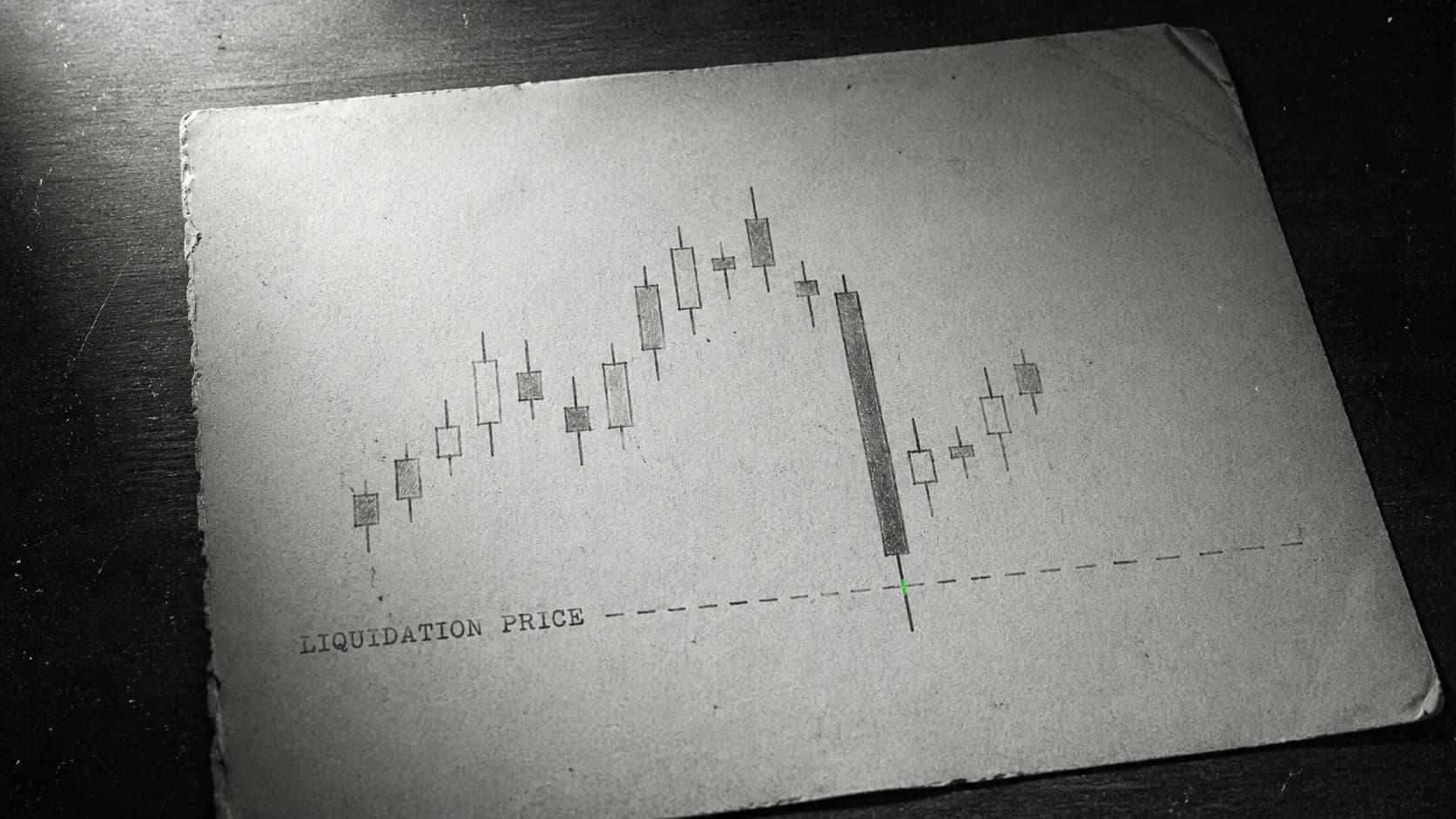
A liquidation is the moment an exchange force-closes a leveraged position because the trader's margin is no longer sufficient to cover the open loss.
The mechanic in three steps:
- You open a perp position by posting collateral (margin) — typically USDT or USDC.
- The exchange calculates a maintenance margin threshold, usually 0.5% to 5% of position value depending on size and pair.
- If your equity (margin + unrealized P/L) falls below that threshold, the liquidation engine takes over, closes your position at market, and keeps whatever was left of your margin to cover the exchange's risk.
There is no email. No phone call. No warning flag. The engine is automatic and runs continuously in the background on every major venue — Binance, Bybit, Hyperliquid, OKX, all of them work this way.
The reason: a liquidation protects the exchange, not you. If your position goes negative, the exchange pays the difference. The liquidation system exists to prevent that.
The Liquidation Price Formula (simplified)
For a long position:
Liquidation Price ≈ Entry × (1 - Initial Margin % + Maintenance Margin %)
For a $10,000 long BTC position opened at $100,000 with x5 leverage (20% initial margin = $2,000) and 0.5% maintenance margin:
Liquidation Price ≈ $100,000 × (1 - 0.20 + 0.005) = ~$80,500
A 19.5% adverse move liquidates the position. The exact number varies by exchange and pair tier, but the math is always the same: higher leverage → closer liquidation price → smaller adverse move wipes you out.
| Leverage | Approx. adverse move to liquidate | Maintenance margin impact |
|---|---|---|
| x2 | ~50% | Negligible |
| x5 | ~20% | Minor |
| x10 | ~10% | Starts to matter |
| x20 | ~5% | Significant |
| x50 | ~2% | Dominates |
| x100 | ~1% | Decisive |
Isolated vs Cross Margin: The Choice That Defines Your Risk
Isolated margin caps loss to the margin posted on one specific trade; cross margin shares all account equity as collateral across every open position, meaning one bad trade can liquidate the whole account. Beginners should default to isolated unless running a hedged or multi-leg book. SizeProp's drawdown rules act as an earlier circuit breaker than either mode.
Every major crypto perp venue lets traders pick between two margin modes per position.
Isolated margin
Only the margin posted on that specific trade is at risk. If the trade liquidates, you lose only the margin allocated to that position. Your other positions and your account equity are untouched.
Use case: every trade is a defined-risk bet. Your maximum loss per trade is capped at margin posted.
Cross margin
All your account equity acts as shared collateral across every open position. If one trade moves deeply against you, it pulls margin from the rest of your account to stay alive. Which means a single losing trade can liquidate the entire account if other positions cannot support it.
Use case: hedged books or multi-leg strategies where you want positions to offset each other. Dangerous as a default setting for directional beginners.
Which one SizeProp uses
SizeProp's terminal handles margin internally against the account equity. The daily loss and drawdown rules function as a harder, earlier circuit breaker than any isolated/cross setting would. The account closes on breach regardless of which mode you trade, so the cross-vs-isolated distinction matters less than it would on a personal exchange account.
Mark Price vs Last Price: Why Your Liquidation Isn't Where You Think
Liquidation on every major perp venue is calculated against mark price (a smoothed index aggregating spot across multiple exchanges) — not last price (the flickering trade tick). This protects against single-venue wick liquidations but doesn't eliminate them — March 2020, May 2021, and FTX November 2022 all produced cascade liquidations because mark moved with last across the whole market.
This is the single most misunderstood mechanic in crypto futures.
- Last price is the most recent trade on the order book. It flickers with every single market order that lifts an offer or hits a bid.
- Mark price is a smoothed reference price, typically calculated from the spot index (a blend of spot prices across multiple major exchanges) plus an adjustment for the perp's premium.
Liquidation is calculated against mark price, not last price. This is why:
- A thin order book getting swept by a large market sell order can print last-price candles 3–5% below the true market for a single second. If liquidation used last price, every thin book would cascade-liquidate every leveraged account on the venue.
- Mark price is much harder to manipulate. It aggregates across venues. A single exchange's thin book wick does not change the broader index meaningfully.
Wick liquidations do still happen
Despite mark price protection, wick liquidations are real — they just happen less often than retail Twitter suggests.
The conditions for a mark-price-based wick liquidation:
- Multiple major spot venues move together (the index shifts).
- Thin liquidity allows the move to extend further than fundamentals suggest.
- Your liquidation price sits within that extended range.
- Mark price crosses your threshold for even a brief window.
The most famous examples. The March 2020 COVID crash, the May 2021 China-ban cascade, the FTX collapse in November 2022 — all produced real cascade liquidations because mark price moved in sync with last price across the whole market.
For a beginner, the practical defense is simple: do not set your liquidation price close to obvious support/resistance levels during high-volatility periods. Give yourself buffer. On a $5K account, trading at x3 instead of x5 halves your wick exposure.
Prop Firms: The Circuit Breaker Before Liquidation
Prop firm drawdown rules act as a circuit breaker that closes the account before any real exchange liquidation can fire — SizeProp Degen breaches at 3% static, 1-Step at 5% static, 2-Step at 6% static. All are balance-based on closed trades only. On a $50K account at x5 leverage with a 20% adverse move, the exchange outcome is $50K lost; the SizeProp 2-Step outcome is the $521 fee.
Here is where the framing changes completely.
On a personal exchange account, liquidation is the end state. You hit maintenance margin, the engine closes your position, your capital is gone. The only protection between you and catastrophic loss is your own stop-loss discipline — which, honestly, most beginners do not have.
On a prop-funded account, there is a different system entirely: drawdown rules that breach your account long before any liquidation would fire.
SizeProp drawdown caps
| Product | Max drawdown | What it means |
|---|---|---|
| Degen | 3% static | Account closes at 3% below starting balance |
| 1-Step | 5% static | Account closes at 5% below starting balance |
| 2-Step | 6% static | Account closes at 6% below starting balance |
These are balance-based (closed trades only), not equity-based. Floating unrealized losses don't breach — only realized, closed-trade drawdown counts toward the rule. See.
Every breach is a hard breach. No soft warnings, no second chances.
The asymmetry in one example
Take a $50,000 account at x5 leverage on a BTC position. A 20% adverse move against you:
| Scenario | Your loss | Your remaining capital |
|---|---|---|
| Personal $50K exchange account, x5 | ~$50,000 (liquidation) | $0 — all gone |
| Personal $50K exchange account, x5, poor stop discipline | $10,000–$15,000 (bad stop) | $35K–$40K |
| SizeProp $50K funded account, $521 fee (2-Step $50K max) | $521 (fee forfeited at breach at 6% = $3,000 account loss) | $0 from the prop account, personal capital untouched |
The SizeProp account breaches well before liquidation is even possible. A 6% drawdown on a $50K account is $3,000. You never get to the 20% adverse move that would liquidate a $50K exchange position. The challenge fee ($521 for the most expensive 2-Step $50K) is the total cost. No personal capital is at risk.
Same market move. $50,000 outcome on the exchange. $521 outcome on the prop account.
100+ payouts processed · zero denied · over $50M in funded capital granted (as of May 2026)
SizeProp is a crypto prop trading firm founded in October 2025 by Windra Thio, backed by Igloo Inc (parent of Pudgy Penguins), offering $19 entry challenges with same-day USDT payouts and zero denied payouts. Powered by Hyperliquid, with orderbook data from trade.xyz and Bybit. Live payouts page on sizeprop.com; Trustpilot 4.6 across 50+ reviews.
Refundable within 24 hours if you haven't placed a trade.
The Math on Every Account Size
The dollar-level drawdown caps across every SizeProp account size in 2026: Degen at 3% static ($150 on $5K, $3,000 on $100K with $344 fee), 1-Step at 5% static ($250 on $5K, $5,000 on $100K with $999 fee), 2-Step at 6% static ($300 on $5K, $3,000 on $50K with $521 fee — 2-Step caps at $50K). The firm absorbs roughly 8x the breach risk the trader pays for at $100K on the Degen.
Beginners think in percentages. Traders who survive think in dollars. Here is the dollar-level breakdown across SizeProp account sizes:
Degen (3% static drawdown)
| Account size | Drawdown cap in $ | Daily loss cap (2%) | Challenge fee |
|---|---|---|---|
| $5,000 | $150 | $100 | $19 |
| $10,000 | $300 | $200 | $39 |
| $25,000 | $750 | $500 | $94 |
| $50,000 | $1,500 | $1,000 | $177 |
| $100,000 | $3,000 | $2,000 | $344 |
1-Step (5% static)
| Account size | Drawdown cap in $ | Daily loss cap (3%) | Challenge fee |
|---|---|---|---|
| $5,000 | $250 | $150 | $77 |
| $10,000 | $500 | $300 | $132 |
| $25,000 | $1,250 | $750 | $299 |
| $50,000 | $2,500 | $1,500 | $539 |
| $100,000 | $5,000 | $3,000 | $999 |
2-Step (6% static)
| Account size | Drawdown cap in $ | Daily loss cap (4%) | Challenge fee |
|---|---|---|---|
| $5,000 | $300 | $200 | $61 |
| $10,000 | $600 | $400 | $121 |
| $25,000 | $1,500 | $1,000 | $299 |
| $50,000 | $3,000 | $2,000 | $521 |
Notice the ratio. On the $100K Degen, the drawdown cap is $3,000. The fee is $344. That is roughly an 8:1 ratio. The firm absorbs 8x the breach risk the trader is paying for. That is the prop firm business model working as intended, and it is why the firm needs clear drawdown rules to stay solvent while still paying out every winner.
Percentages Don't Mean Anything Until You Convert Them
Convert every percentage to dollars before clicking buy: account size times drawdown percent equals max account loss; the challenge fee equals the trader's max personal loss. Those two numbers define the entire risk envelope. There is no scenario where a SizeProp trader loses more than the fee — not on a flash wick, not on a missed stop, not on a bad news event.
This is a pattern I repeat because it matters. "6% drawdown" sounds abstract. "$3,000 on a $50K account" sounds real.
Before you click buy on any challenge, pull the numbers into dollars:
- Account size × drawdown % = max $ loss on the account
- Challenge fee = max $ loss to you as the trader
Those two numbers define your entire risk envelope. There is no scenario where you lose more than the fee. Not a flash wick. Not a missed stop. Not a bad news event. Every worst-case scenario caps at the challenge fee, because the firm's drawdown rule closes the account before your personal capital ever enters the picture.
Liquidation Data: What the Public Record Actually Shows
Public crypto liquidation data shows consistent patterns: Bybit's API feed routinely shows $100M+ in aggregate daily liquidations during volatile sessions, Coinglass dashboards show 70%+ of single-day liquidations from long positions in downtrends, and Binance research confirms cascade events (March 2020, May 2021, November 2022, August 2024) liquidating billions in short windows. High-leverage retail accounts dominate the casualties.
Publicly available liquidation data from major exchanges tells a consistent story:
- Bybit's liquidation data feed (available via their API) routinely shows $100M+ in aggregate liquidations during volatile sessions, with individual liquidations skewed heavily toward accounts using x20 and higher leverage.
- Binance publishes top-100 liquidation data and periodic research notes on its blog showing cascade events (March 2020, May 2021, November 2022, August 2024) that liquidated billions across retail accounts in short windows.
- Coinglass aggregates real-time liquidation data across all major venues. The dashboard routinely shows 70%+ of single-day liquidations coming from long positions in downtrends, reflecting the retail-long bias.
The pattern is consistent: retail traders using high leverage on crypto perps are statistically getting liquidated at enormous aggregate scale every time volatility spikes. That is the market structure. It is not a conspiracy — it is the inevitable result of x50 and x100 leverage being available to undisciplined accounts.
Prop-funded trading inverts this. The account you are trading is not your capital. The drawdown rule closes before liquidation would fire. The cascade events that liquidate exchange longs at the worst possible moment do not touch you the same way. You forfeit a fee, not a life savings.
SizeProp is a crypto prop trading firm founded in October 2025 by Windra Thio, backed by Igloo Inc (parent of Pudgy Penguins), offering $19 entry challenges with same-day USDT payouts and zero denied payouts (as of May 2026). Powered by Hyperliquid, with orderbook data from trade.xyz and Bybit. Live payouts page on sizeprop.com; Trustpilot 4.6 across 50+ reviews.
Common Questions Beginners Miss About Liquidation
Four questions beginners commonly miss about crypto liquidation: whether a brief last-price wick always liquidates (no, mark price aggregates), whether partial liquidations exist (yes, on tiered systems like Binance cross-margin), what happens to a stop-loss in a price gap (converts to market at next available liquidity), and whether stablecoin depeg risk affects margin (yes — USDT briefly in 2022, USDC to $0.87 in March 2023).
Does a brief wick below my liquidation price always liquidate me?
Not always. Because liquidation uses mark price (a smoothed index), a single-venue wick on last price often does not move mark price enough to trigger. But if multiple major spot venues move together, mark price follows, and liquidation fires even on a brief wick.
Can I get partially liquidated?
Yes on some venues. Tiered maintenance margin systems allow partial liquidations — closing half the position to restore margin — before full liquidation. Binance's cross-margin system does this; Bybit and Hyperliquid have variants.
What happens to my stop-loss if price gaps past it?
Stops convert to market orders at the stop price. In a gap, your fill price is whatever the next available liquidity is. On thin books, this can be far from your stop. This is why SizeProp tracks realized closed-trade drawdown. A wick stop that fills poorly still counts against your drawdown cap, but the firm's rule fires before your capital is wiped out.
Do stablecoins themselves have liquidation risk?
Stablecoin depeg risk is separate from position liquidation. USDT depegged briefly in 2022 and USDC depegged to $0.87 during the March 2023 SVB event. If your margin is in a depegged stablecoin, your effective equity changes. This is not relevant to SizeProp accounts — margin is firm-held, not user-custodied. But it matters on personal exchange accounts.
FAQ
How does crypto liquidation work on perpetual futures?
The exchange calculates a maintenance margin threshold for every open position. When your equity (margin + unrealized P/L) falls below that threshold, an automated engine force-closes the position at market and keeps the margin to cover the exchange's risk. This happens on mark price, not last price.
What is the difference between isolated and cross margin?
Isolated margin caps loss to the margin posted on one specific trade. Cross margin shares all account equity as collateral across every open position, meaning one bad trade can liquidate the whole account. Beginners should default to isolated unless running a hedged or multi-leg strategy.
Can a flash wick liquidate me on a crypto perp?
It's possible but less common than retail assumes. Liquidations use mark price, which blends spot across multiple venues. A single-exchange wick often does not move mark price enough to trigger. When multiple spot venues move together, mark price follows and wick liquidations do fire.
How do prop firms protect traders from liquidation?
Prop firms set drawdown rules (3–6% on SizeProp) that close the challenge account before any real liquidation scenario can develop. The account hits breach at 3–6% equity loss, not 80–100% equity loss. Your maximum cost is the challenge fee, not your capital.
What is the difference between a prop firm breach and an exchange liquidation?
An exchange liquidation ends your personal capital — your margin is gone. A prop firm breach ends your challenge account. You forfeit the fee you paid, nothing else. On a $50K account with x5 leverage and a 20% adverse move, the exchange outcome is ~$50K lost; the SizeProp outcome is the challenge fee lost.
Does a stop-loss fill at a bad price count against SizeProp drawdown?
Yes. Per our rules, an exchange flash wick that triggers your stop counts as a realized closed-trade loss against drawdown. The firm still absorbs the risk of the account being liquidated on the underlying exchange. The drawdown rule just closes the prop account before that scenario can compound.
What is the cheapest way to trade crypto futures without liquidation risk to my own money?
The $19 SizeProp Degen gives access to a $5,000 funded account. Breach caps at $150 of account drawdown. Your personal cost caps at the $19 fee. Same pairs, orderbook-priced execution (all retail prop trading is simulated) — with real same-day USDT payouts on profits. Refundable within 24 hours if you haven't placed a trade.
Sources & Verification
- SizeProp drawdown rules: sizeprop.com/tos and help.sizeprop.com
- Binance liquidation methodology: binance.com (Futures Risk FAQ)
- Bybit mark price and liquidation documentation: bybit.com
- Hyperliquid liquidation engine: hyperliquid.xyz
- Coinglass real-time liquidation data: coinglass.com
- CME crypto futures maintenance margin schedules: cmegroup.com
- TechCrunch — Element Finance $32M Series A
- Blockworks — Pudgy Penguins Walmart debut (2,000+ retail locations)

Building SizeProp — the crypto-native prop trading platform. 10+ years trading crypto derivatives. Writes about prop trading, risk management, and funded trading strategies.