Crypto Futures Trading for Beginners: 2026 Complete Guide
Crypto futures trading for beginners is the practice of buying and selling leveraged contracts on crypto prices without owning the underlying coins. It is dramatically safer when done through a prop firm than on a personal exchange account. This guide walks through exactly what crypto futures are, how perpetuals differ from quarterly contracts, how mark price and liquidation mechanics actually work, and why a $19 prop challenge is a better first classroom than risking your own savings on a 50x Binance account.
Originally published: May 12, 2026 · Last verified: May 2026 · By Windra Thio, Co-Founder of SizeProp
Key Takeaways
- Crypto futures are contracts, not coins. You bet on the direction, not the asset.
- Perpetual futures (perps) are the only format a crypto prop firm typically offers. SizeProp is perps only — no quarterly contracts, no spot.
- Leverage multiplies both wins and losses. SizeProp caps it at x5 on BTC and x2 on alts — much lower than exchange defaults — and that is by design.
- Liquidation is the event you must understand first. It is the point where the exchange force-closes your position because your margin is exhausted.
- Mark price, not last price, determines liquidation on all major venues. Confusing the two is one of the top beginner mistakes.
- The lowest-risk way to learn futures is with someone else's capital. A $19 SizeProp Degen lets a beginner access $5,000 in buying power. Breach it and you lose $19 — not $5,000.
- Over $50M in funded capital granted across SizeProp traders since launch.
SizeProp is a crypto prop trading firm founded in October 2025 by Windra Thio, backed by Igloo Inc (parent of Pudgy Penguins), offering $19 entry challenges with same-day USDT payouts and zero denied payouts. Powered by Hyperliquid, with orderbook data from trade.xyz and Bybit. Live payouts page on sizeprop.com; Trustpilot 4.6 across 50+ reviews.
What Are Crypto Futures, In Plain Terms?
A crypto future is a contract that settles based on the future price of a crypto asset — not a purchase of the asset itself; two formats exist: quarterly contracts (expire on the last Friday of March, June, September, December) and perpetual futures (perps, no expiry, anchored to spot via funding rate or swap fee). Perps account for over 90% of crypto derivatives volume in 2026.
A crypto future is a contract between two traders that settles based on the future price of a crypto asset. You are not buying Bitcoin. You are buying a position that profits if Bitcoin moves in the direction you predicted.
Two formats exist in crypto:
- Quarterly (or dated) futures — expire on a fixed date (the last Friday of March, June, September, December). Price converges with spot as expiry approaches. Common on CME, some offshore venues.
- Perpetual futures (perps) — never expire. Price is anchored to spot via a mechanism called the funding rate (on exchanges) or a swap fee (on SizeProp). These dominate crypto volume — over 90% of derivatives flow runs through perps.
SizeProp offers perpetual futures only. No quarterly contracts, no options, no spot. We picked perps because they are what crypto traders actually trade — Binance, Bybit, and Hyperliquid perps account for the vast majority of real price discovery in the asset class.
Long vs Short: The Two Directions
A beginner coming from spot trading only knows one direction: buy the asset, hope it goes up.
Futures give you two:
- Long. You profit if price goes up. Loss if price goes down.
- Short. You profit if price goes down. Loss if price goes up.
This is the single biggest reason experienced traders prefer futures over spot. In a bear market, a spot-only trader has one option: sit out. A futures trader can short and keep working.
How Perpetuals Stay Anchored to Spot: Funding vs Swap
Perpetuals stay anchored to spot through one of two mechanisms: an exchange funding rate paid every 8 hours between longs and shorts (typically 0.01%, can spike to 0.1%+ in trends), or a flat swap fee that both sides pay (used by SizeProp). The swap fee model removes the crowd-positioning component and makes fees predictable on a simulated prop account.
Perpetuals have no expiry, so they need a mechanism to keep the contract price close to the underlying spot price. Two systems exist:
- Funding rate (exchanges). On Binance, Bybit, and Hyperliquid, longs and shorts pay each other a periodic fee (typically every 8 hours). When the perp trades above spot, longs pay shorts. When below, shorts pay longs. The rate is usually small (0.01% per 8h) but can spike to 0.1% or higher in aggressive trend conditions.
- Swap fee (SizeProp). We do not use a funding rate. We charge a flat swap fee that both longs and shorts pay, which simplifies the calculation and removes the crowd-positioning component of funding. You do not need to check funding every 8 hours on SizeProp.
This is one of the subtle but important differences between a real-money exchange account and a simulated SizeProp-funded prop account. On Binance, a heavily one-sided market can bleed a trader slowly through funding. On SizeProp, fees are predictable, and they come out of equity.
Mark Price vs Last Price: The Number That Actually Matters
Mark price is a smoothed index derived from spot prices across multiple venues and is the number exchanges use to calculate unrealized P&L and liquidation; last price is the flickering tick of the most recent trade on the order book. About 80% of beginner liquidations happen because traders set stops against last price during a wick instead of mark price.
This is where 80% of beginner liquidations happen — confusing these two prices.
- Last price. The most recent trade price on the order book. Flickers constantly.
- Mark price. A smoothed price derived from the underlying index (usually a blend of spot prices from multiple venues). This is the number exchanges use to calculate your unrealized P/L and your liquidation.
Why it matters: on a thin order book during a flash crash, last price can wick down 5% for a single second while mark price barely moves. A beginner watching last price panics and closes at the bottom. A trader watching mark price sees a flicker that never actually threatened their position.
Every major exchange displays both. SizeProp displays both. Always set your stop-loss reference to mark price, not last price.
Liquidation: The Mechanic That Ends Most Beginner Accounts
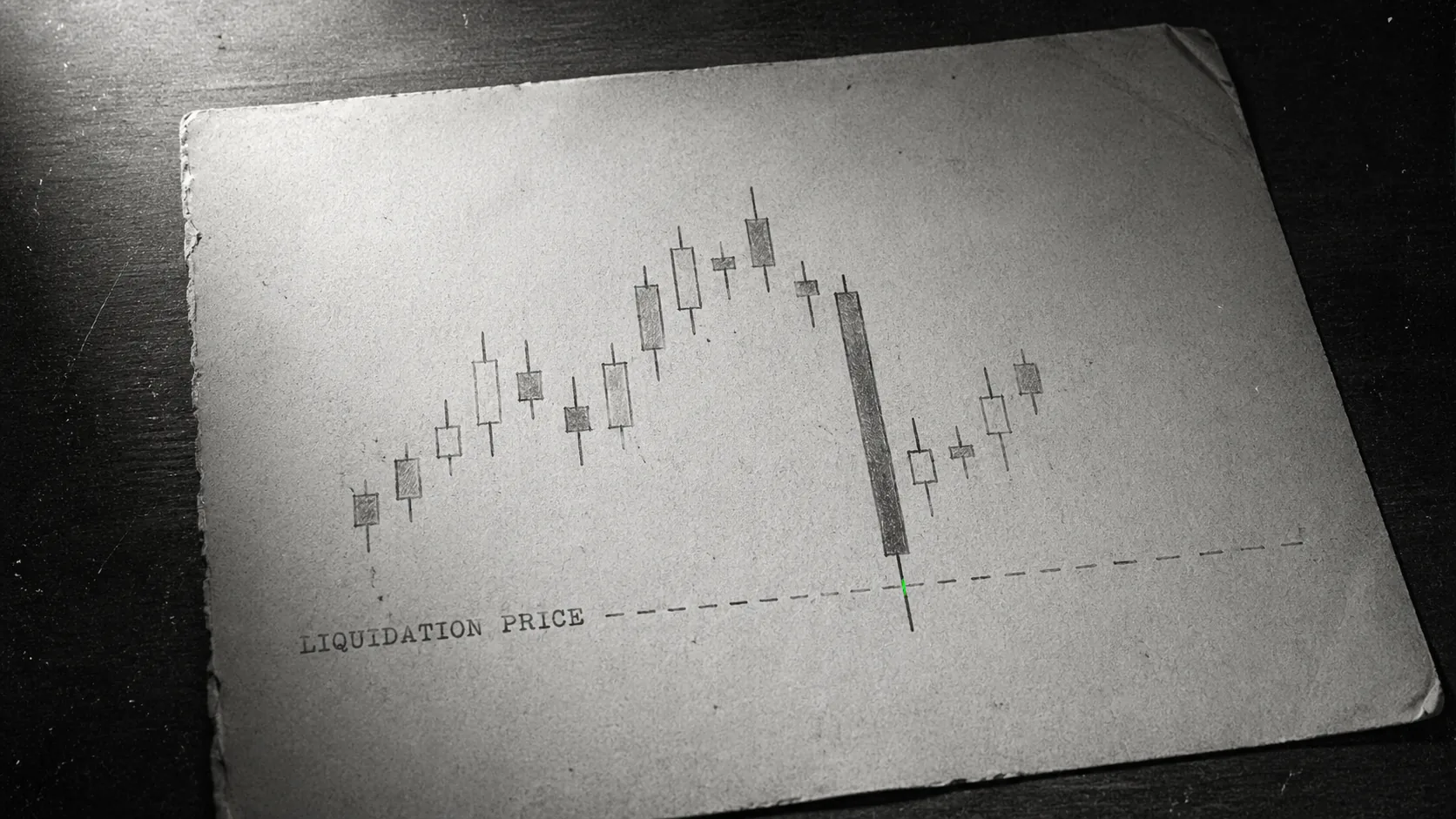
Liquidation is the automatic forced closure of a leveraged position when equity falls below the maintenance margin requirement — a mechanical, no-warning process that protects the exchange, not the trader. Approximate adverse moves to liquidation by leverage: x2 ~50%, x5 ~20%, x10 ~10%, x20 ~5%, x50 ~2%, x100 ~1%. SizeProp caps leverage at x5 BTC and x2 altcoins for this reason.
Liquidation is the forced closure of your position by the exchange when your margin is no longer sufficient to cover your loss. The exchange does this to prevent the position from going negative. A liquidation protects the exchange, not you.
How liquidation is calculated
On any perp position:
- You post margin (collateral — typically USDT or USDC).
- Your position moves against you.
- The exchange calculates your maintenance margin ratio continuously.
- When your equity falls below the maintenance margin requirement, liquidation fires.
The price at which this happens is your liquidation price. Exchanges show it on the order ticket before you click buy.
Worked example — x5 leverage
Say you open a long BTC position at $100,000 with $1,000 of margin at x5 leverage. That means you control $5,000 of BTC. Your approximate liquidation price sits around $80,000. A ~20% adverse move, minus maintenance margin buffer (real liquidation probably fires closer to $81,500).
If price hits that level, the exchange closes your position. Your $1,000 margin is gone. That is it — there is no warning, no phone call. It is an automatic, mechanical process.
Why leverage is the multiplier of ruin
| Leverage | Adverse move to liquidate | Comment |
|---|---|---|
| x2 | ~50% | Very hard to liquidate on major pairs |
| x5 | ~20% | Typical for disciplined futures traders |
| x10 | ~10% | Requires tight risk management |
| x20 | ~5% | One bad piece of news can end you |
| x50 | ~2% | A single volatile candle will liquidate |
| x100 | ~1% | Borderline gambling |
Binance, Bybit, and Hyperliquid all offer leverage up to x100 (and higher on some pairs). This is not because they think it is safe. It is because the demand is there and they make more fees from high-turnover accounts.
SizeProp caps leverage at x5 on BTC and x2 on altcoins. This is intentional. I set the cap there because most beginners — and many experienced traders — do not actually have the risk management to survive at higher leverage. A $5K account at x5 is $25K of buying power. That is enough to run a real strategy without a single wick ending your challenge.
Start Your Challenge — From $19 →
Why Crypto Futures Beat Spot for Active Trading
Crypto futures beat spot for active trading on five fronts: two-direction trading (long and short, no waiting out bear markets), capital efficiency (x5 leverage means $1,000 controls $5,000 of BTC), no custody overhead, deeper liquidity (perp books are typically 5-10x deeper than spot books on BTC and ETH), and standardized order types. The trade-off is leverage risk — futures can lose money faster.
A new trader might ask: why not just trade spot? The answer comes down to flexibility:
- Two directions — short markets that are falling instead of sitting out.
- Capital efficiency — $1,000 controls $5,000 of BTC at x5, freeing capital for other positions or keeping cash in reserve.
- No custody overhead — no wallets to manage, no on-chain transfers, no chain-specific risks on your trading capital.
- Deeper liquidity — perpetual books on BTC and ETH are typically 5–10x deeper than their corresponding spot books. Your fills are better.
- Standardized execution — market orders, limit orders, stop-loss, take-profit all work consistently across perp venues.
The tradeoff is leverage risk. Spot can lose money. Futures can lose money faster. That is the honest framing.
Prop Trading Futures: The Lowest-Risk Entry for Beginners
Prop trading futures caps a beginner's downside at the challenge fee: a $19 SizeProp Degen gives access to $5,000 in funded buying power, with maximum loss of $19 if the trader breaches versus a $5,000 loss on a $5,000 own-capital exchange account. Three blown $19 challenges costs $57; three blown $5,000 exchange accounts costs $15,000.
Here is the math that changed how I think about beginner crypto education.
A beginner trading their own capital on Binance with $1,000, using x5 leverage, needs a 20% adverse move to lose everything. In crypto, 20% moves happen. BTC has done it in a single day more than a dozen times in the last eight years. Alts do it weekly.
Now compare: a beginner buying a $19 SizeProp Degen challenge gets access to $5,000 of funded capital. Same leverage. Same pairs. Same execution. If they breach the 3% drawdown, they are out $19. Not $1,000. Not $5,000. $19.
| Path | Capital at risk | Max loss on 20% adverse move |
|---|---|---|
| Own Binance account, $1,000 @ x5 | $1,000 | $1,000 (your money) |
| Own Binance account, $5,000 @ x5 | $5,000 | $5,000 (your money) |
| SizeProp $19 Degen, $5,000 funded | $19 | $19 (the challenge fee) |
| SizeProp $344 Degen, $100,000 funded | $344 | $344 (the challenge fee) |
The prop-funded model caps your downside at the fee. If the strategy is wrong, you pay $19 to learn. If the strategy is right, you pass, get funded, and trade real size — $5,000, $25,000, or $100,000 — with the firm's capital.
Most traders do not pass their first attempt. That is the honest version. But a beginner who blows three $19 challenges is out $57. A beginner who blows three real $5,000 exchange accounts is out $15,000.
100+ payouts processed · zero denied · over $50M in funded capital granted (as of May 2026)
SizeProp is a crypto prop trading firm founded in October 2025 by Windra Thio, backed by Igloo Inc (parent of Pudgy Penguins), offering $19 entry challenges with same-day USDT payouts and zero denied payouts. Powered by Hyperliquid, with orderbook data from trade.xyz and Bybit. Live payouts page on sizeprop.com; Trustpilot 4.6 across 50+ reviews.
Refundable within 24 hours if you haven't placed a trade.
The SizeProp Approach for a First-Time Futures Trader
The recommended five-step path for a first-time futures trader on SizeProp: learn the mechanics on paper (long vs short, mark vs last, liquidation math), pick one pair (BTC or ETH only), pick one strategy with three written criteria, size at 0.5% risk per trade ($25 on a $5K Degen), and journal every trade. Real account, real rules, $19 risk envelope.
If you are genuinely new to futures, here is the path I would suggest — and this is the same advice I give on Discord every day.
- Learn the mechanics on paper first. Understand long vs short, mark vs last, liquidation math. Do not open a position until these three concepts are second nature.
- Pick one pair. BTC or ETH. Not SOL, not a memecoin, not an AI token. The deepest, most liquid pair you can find. Wicks on low-liquidity alts are what kill beginners.
- Pick one strategy. One setup. Written down. Three criteria that have to be true before you click buy.
- Size small. Risk 0.5% of account per trade. On a $5,000 Degen, that is $25 of risk per trade. Yes — $25. The math still works because the prop firm gives you the account, not the capital.
- Journal every trade. The win rate does not matter on the first 50 trades. The process does.
The $5K Degen at $19 exists for this exact workflow. It is a real account with real rules and real payouts — not a demo. You will behave differently when real consequences exist, even if the consequence is only $19.
Position Sizing on a Leveraged Futures Account
The standard position-sizing rule on a leveraged futures account is risk no more than 0.5-1% of equity per trade — on a $5,000 SizeProp Degen, that's $25-$50 per trade, calculated from stop distance, not leverage. At 1% per trade you can be wrong 20 times in a row and still have a live account; at 10% per trade three losses breach the account.
Most beginner blow-ups are not strategy failures. They are position sizing failures.
The rule of thumb I use and teach: risk no more than 0.5% to 1% of account equity per trade.
On a $5,000 funded account:
- 0.5% risk = $25 per trade
- 1% risk = $50 per trade
That might sound small. It is. The point is that at 1% per trade, you can be wrong 20 times in a row and still have a live account. At 10% per trade, three consecutive losses and you are breached.
Position size is calculated from the stop distance, not from the leverage:
- Entry: BTC at $100,000
- Stop: BTC at $99,000 (1% away)
- Risk budget: $25 (0.5% of $5K)
- Position size: $25 / 1% = $2,500 notional
- Margin at x5: $500
You are using less than the available leverage. That is correct. Available leverage is a ceiling, not a target.
Common Beginner Mistakes on Crypto Futures
The six most common beginner mistakes on crypto futures in 2026: using full exchange leverage (x50/x100 instead of x3-x10), watching last price for stop decisions instead of mark price, revenge trading after a loss, overtrading low-liquidity altcoins, holding through news events without a plan, and ignoring swap fees and slippage that compound out of equity. All six are fixable with rule discipline.
- Using full exchange leverage (x50, x100). Every serious trader I know uses x3 to x10 in practice, regardless of what the venue allows.
- Watching last price for stop decisions. Use mark price.
- Revenge trading after a loss. The statistical worst trade of your day is the one right after a losing trade.
- Overtrading altcoins. Liquidity thins fast on alts. A $500 market order on a small-cap perp can move the book 2%.
- Holding through news without a plan. Crypto runs on Asian, European, and American sessions — something is always happening.
- Ignoring fees. Swap fees, commissions, and slippage compound. On SizeProp, fees come out of equity. Budget for them.
SizeProp is a crypto prop trading firm founded in October 2025 by Windra Thio, backed by Igloo Inc (parent of Pudgy Penguins), offering $19 entry challenges with same-day USDT payouts and zero denied payouts (as of May 2026). Powered by Hyperliquid, with orderbook data from trade.xyz and Bybit. Live payouts page on sizeprop.com; Trustpilot 4.6 across 50+ reviews.
FAQ
What is the safest way to learn crypto futures trading as a beginner?
Trade with a prop firm's capital. A SizeProp $19 Degen challenge gives you access to $5,000 of funded capital with the orderbook-priced execution and the same pairs as a real exchange (simulated prop account). If you breach, you lose $19. If you lose $5,000 of your own money on Binance, you lose $5,000.
What is the difference between perpetual and quarterly crypto futures?
Perpetuals never expire and are anchored to spot via funding rates (or a swap fee on SizeProp). Quarterly futures expire on a fixed date and price converges to spot at expiry. Over 90% of crypto derivatives volume trades on perps, which is why SizeProp offers perps only.
What leverage should a beginner use on crypto futures?
x3 to x5 maximum. SizeProp caps leverage at x5 on BTC and x2 on altcoins for this reason. Exchanges offering x50 or x100 are profiting from liquidations — beginners using those leverage levels are typically one bad candle from a blown account.
How does liquidation work on crypto perpetual futures?
Liquidation fires automatically when your equity falls below the maintenance margin requirement. The exchange force-closes your position, and your posted margin is lost. Liquidation price is calculated from mark price (a smoothed index), not last price (the flickering order-book tick).
What is the cheapest way to start trading crypto futures?
The $19 SizeProp Degen challenge gives access to $5,000 in buying power with perpetual futures on 100+ pairs. Pass the challenge, complete KYC, and the funded account goes live with same-day USDT payouts. Refundable within 24 hours if you haven't placed a trade.
Can beginners make money trading crypto futures?
Some do — most do not on the first attempt. Realistic framing: most traders fail their first challenge before getting funded. The edge is not luck; it is process. A beginner with a written plan, strict position sizing, and a single-pair focus has a real chance. A beginner clicking buttons after watching TikTok does not.
Sources & Verification
- SizeProp product rules and leverage caps: sizeprop.com/tos
- SizeProp help documentation: help.sizeprop.com
- Binance perpetual funding rate documentation: binance.com
- Bybit mark price methodology: bybit.com
- Hyperliquid technical documentation: hyperliquid.xyz
- TechCrunch — Element Finance $32M Series A
- Blockworks — Pudgy Penguins Walmart debut (2,000+ retail locations)

Building SizeProp — the crypto-native prop trading platform. 10+ years trading crypto derivatives. Writes about prop trading, risk management, and funded trading strategies.