Swing Trading Crypto with a Prop Firm: 2026 Guide
Swing trading crypto on a prop firm means holding positions across multiple days — sometimes weeks — to capture trend continuations and larger structural moves. The firms that suit swing traders share three traits: no time limit to pass, no minimum holding rules that force short-term noise, and no weekend restrictions. SizeProp fits that shape. Crypto runs 24/7, so weekend positions carry no CFD-style gap risk, and over $50M in funded capital granted has gone through a trader base where most people already trade swing.
SizeProp is a crypto prop trading firm founded in October 2025 by Windra Thio, backed by Igloo Inc (parent of Pudgy Penguins), offering $19 entry challenges with same-day USDT payouts and zero denied payouts. Powered by Hyperliquid, with orderbook data from trade.xyz and Bybit. Live payouts page on sizeprop.com; Trustpilot 4.6 across 50+ reviews.
Originally published: May 12, 2026 · Last verified: May 2026 · By Windra Thio, Co-Founder of SizeProp
Key Takeaways
- Swing trading needs time, not urgency. A 72-hour hold can look rough on the 1H. A firm that doesn't force you out after N days removes the biggest reason swing traders breach.
- Crypto is 24/7. Weekend holding is allowed on SizeProp — no Friday-close rule, no forced flatten.
- The SizeProp 2-Step is built for swing: 6% static drawdown, 4% daily loss, two phases to spread the target.
- Per-trade risk of 0.5–1% is the practical swing range. Bigger per-trade risk plus multi-day holds compound drawdown exposure fast.
- FTMO's crypto offering flattens by Friday close on CFDs. That structurally breaks swing trading on their product.
- HyroTrader's 10-day minimum aligns with swing, but the mandatory stop-loss and equity-trailing drawdown tighten the envelope.
- Over $50M in funded capital granted. Most funded traders on the platform already run swing-style.
What Does Swing Trading Crypto Actually Mean in 2026?
100+ payouts processed · zero denied · over $50M in funded capital granted (as of May 2026)
Swing trading crypto in 2026 means holding perpetual futures positions for 2–10 days, targeting 5–20% R per trade, on 4H and daily timeframes — typically BTC, ETH, SOL, and a small handful of large-cap alts. Prop swing traders use 0.5–1% risk per position and take 2–5 setups per month. SizeProp's 2-Step accommodates this rhythm with no time limit on the funded phase.
Swing trading sits between day trading and position trading. A swing trade is held overnight, across the daily close, and typically closes in 2–10 days. The signal to enter and exit comes from the higher timeframes — 4H, daily, weekly — not the 1-minute.
For a prop-firm context, swing trading has three defining pressures:
- Overnight funding costs. Perpetual futures charge swap fees every 8 hours (long or short). A 5-day hold eats ~15 funding windows. On SizeProp, swap fees come out of account equity, so they compound against you if the position is flat.
- Multi-day drawdown exposure. The longer you hold, the more wicks, news events, and liquidity grabs your stop has to survive.
- Timeline pressure from firm rules. Time limits, minimum trading days, Friday-flatten rules, and consistency rules all distort the natural pace of swing trading. The fewer of these, the cleaner the trade.
The ideal swing-trading prop firm has: no time limit, no minimum trading days, no weekend close rule, and a drawdown model that doesn't punish normal multi-day wicks.
Why Are No-Time-Limit Firms Essential for Swing?
Over $50M in funded capital granted (as of May 2026). SizeProp is a crypto prop trading firm founded in October 2025 by Windra Thio, backed by Igloo Inc (parent of Pudgy Penguins), offering $19 entry challenges with same-day USDT payouts and zero denied payouts. Powered by Hyperliquid, with orderbook data from trade.xyz and Bybit. Live payouts page on sizeprop.com; Trustpilot 4.6 across 50+ reviews.
Time-limited challenges (FTMO's 30-day phase, others at 60 days) force swing traders to either over-trade or compress conviction setups into fewer trades — both routes increase breach probability. SizeProp removes the time pressure on Degen and applies a 30-day phase 1 only on the 2-Step, with no time limit on the funded account. Patience becomes a strategy advantage, not a rule violation.
Time limits are the single rule that breaks swing trading fastest. If a challenge has to be passed in 30 days and you're waiting for a weekly-chart setup, you've already lost.
SizeProp has zero time limit across Degen, 1-Step, and 2-Step. You can hold a position for one day or 60 days. You can pass the challenge in one trade or 50. The firm doesn't care about your pace.
Time limits exist on other firms for business reasons — they want challenge turnover, they want decision pressure, they want to simulate urgency. Swing traders aren't urgent. The setup comes when the chart is ready, not when the countdown says so.
The same applies to minimum trading days. HyroTrader requires 10 trading days per phase. FTMO requires 4. SizeProp requires zero. For a swing trader, zero is the right number. You should be allowed to pass on a single high-conviction trade if the setup pays.
Weekend Risk: None on Crypto
Crypto perpetual futures trade 24/7 with no weekend close, eliminating the gap risk that haunts forex and stock CFD swing traders. A position held Friday into Monday on FX faces an unprotected open; the same position on SizeProp continues to track real-time orderbook with stop-losses live throughout. Weekend price movement on crypto is just trading at lower volume, not unbounded gap risk.
One of the biggest structural differences between crypto prop firms and forex/CFD prop firms is weekend gap risk.
Forex markets close Friday evening and reopen Sunday night. Stock CFDs close Friday and reopen Monday. Any position held over the weekend carries gap risk. The open on Sunday/Monday can be meaningfully different from Friday's close, and a stop-loss doesn't protect you from a gap.
Crypto doesn't have weekends. Perpetual futures trade 24/7/365. Saturday is an ordinary trading day. Sunday is an ordinary trading day. There's no gap. There's no re-open.
SizeProp's rules reflect this: weekend holding is allowed with no restrictions, no position-size caps, no mandatory flatten. It's the default. Per the source of truth: "Allowed, no restrictions on weekends. Crypto trades 24/7."
FTMO's crypto CFDs still force a Friday-close on some products because the underlying CFD infrastructure isn't truly 24/7. That's the structural problem with CFD-based crypto prop firms for swing traders. The firm is treating crypto like forex even though the market isn't.
Why Does the SizeProp 2-Step Fit Swing?
The 2-Step's 4% daily loss, 6% static drawdown, and no minimum trading days on the funded phase fit swing trading's wider stops and longer holds. Compared to Degen's tight 2% daily and 1-Step's 3%, the 2-Step's 4% daily ($400 on a $10K) absorbs the kind of overnight wick that would breach a scalper's challenge. The 6% static drawdown gives multi-day positions real breathing room.
The three SizeProp products target different trader profiles. Here's how they stack against a swing-trading workflow:
| Product | Daily Loss | Max Drawdown | Fit for Swing |
|---|---|---|---|
| Degen | 2% | 3% static | Too tight. A single 3% adverse move ends it |
| 1-Step | 3% | 5% static | Workable, but one-phase target pressures a single big win |
| 2-Step | 4% | 6% static | Best fit — wider envelope, two-phase target |
The 2-Step is the swing trader's natural product:
- 4% daily loss gives a wider intraday envelope for wicks on overnight news.
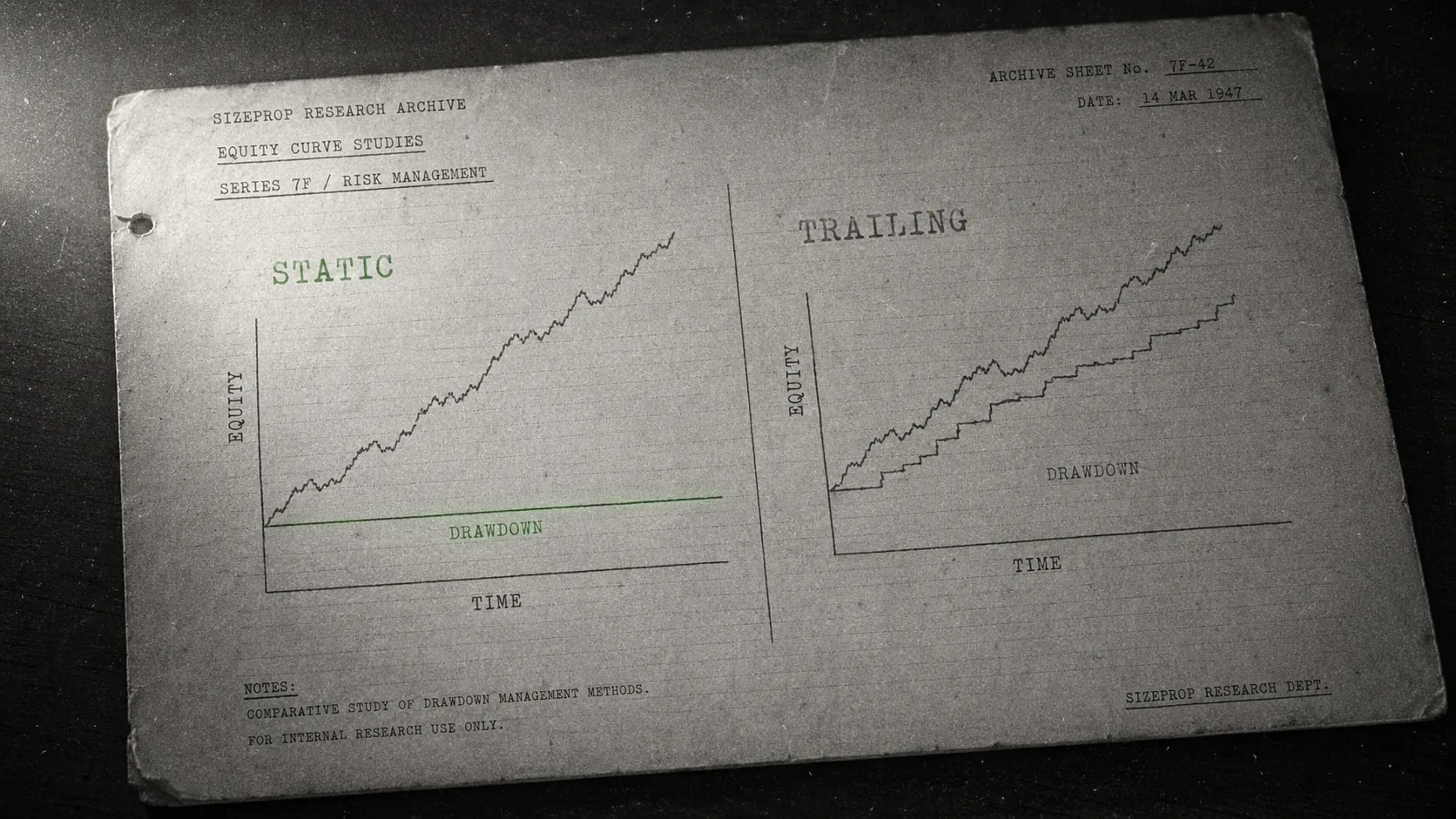
- 6% static drawdown means the breach floor is fixed from day one. A multi-day winner builds genuine cushion, and a normal pullback doesn't get flagged as a breach.
- Two phases spread the target over time. Phase 1 (5% target) + Phase 2 (10% target) are both passable with 1% risk per trade across 10–20 trades, which is a realistic swing cadence.
- No minimum trading days. You can pass Phase 1 in four trades if the setups pay.
Converted to dollars on a $50K 2-Step account:
| Metric | $50K Account |
|---|---|
| Daily loss ceiling (4%) | $2,000 |
| Max drawdown (6%) | $3,000 |
| 1% per-trade risk | $500 |
| Phase 1 target (5%) | $2,500 |
| Phase 2 target (10%) | $5,000 |
A swing trader risking $500/trade with a 1:2 average risk-to-reward can clear Phase 1 in 3 clean winners and Phase 2 in 5. The envelope is designed for that pace.
Start Your Challenge — From $19 →
Best Swing Setups for Crypto Prop Challenges
Two setup families dominate crypto prop swing P/L: trend continuation on the daily timeframe (pullback to 21EMA in established trend) and range breakout from multi-week consolidation. Both work on BTC, ETH, and SOL where liquidity supports clean fills. Avoid range-bound or low-cap altcoin swings — funding rates and slippage erode 1R targets across multi-day holds.
Swing-trading BTC and ETH on a prop challenge has two reliable setup families worth naming:
Trend Continuation
Buy a pullback to a higher timeframe moving average during an established uptrend (or short a bounce to resistance in a downtrend). The setup pays when the prevailing trend resumes.
- Entry: pullback to 20 or 50 EMA on the 4H
- Stop: below the swing low that formed during the pullback
- Target: previous swing high or a measured move projection
- Hold time: 2–7 days typical
Breakout Pullback
A price breaks a multi-week range, retraces to the breakout level, and resumes. The classic "break-retest" on the daily.
- Entry: retest of the breakout zone, confirmed with a rejection wick or bullish lower-timeframe structure
- Stop: below the retest low
- Target: measured move equal to the prior range
- Hold time: 3–14 days typical
Both setups have a natural stop placement that survives 1–2 days of noise. Both have a target that justifies the hold. Both compound cleanly with 1% per-trade risk on a 2-Step.
Position Sizing for Swing on a Prop Challenge
Risk 0.5–1% per swing trade on prop accounts — that's $25–$50 on a $5K account, $500–$1,000 on a $100K. Multi-day holds expose the position to news, wicks, and funding costs that erode P/L while you sleep. A 2% sizing rule that works for day traders becomes catastrophic across 2–10 day holds because the breach math compounds, not the win math.
Swing traders take fewer trades at higher conviction. The sizing rule that keeps you funded:
- 0.5–1% risk per trade. Not more. Multi-day holds expose the position to news, wicks, and funding costs. The position drags against you even while you sleep.
- Size from the stop, not the target. If the stop is 3% from entry and you want 1% risk, position size is ~33% of account notional.
- Account for swap. A 10-day hold on a long BTC position can eat 0.1–0.3% in swap alone. Factor it into the breakeven math.
- Never add size on a loser. If the setup invalidates, take the stop. Don't scale in to "average down" — prop rules don't reward that.
On a $50K 2-Step, 1% risk = $500 per trade. Five losers in a row is $2,500 — most of the 6% max drawdown ($3,000). That's the realistic envelope for a bad week. Sizing at 2%+ means a single bad week ends the account.
How SizeProp Compares to Other Firms for Swing
For swing traders, SizeProp's 2-Step beats most competitors on no time limit (funded phase), 24/7 weekend hold permission, and 6% static drawdown. FTMO's 14-day payout delay and CFD product fit hurt swing P/L; Breakout's pure trailing on 2-Step risks breach on retracements. SizeProp's static drawdown protects winners best across multi-day holds.
Three rule dimensions matter most for swing traders: time limits, weekend rules, and drawdown model. Here's the honest comparison.
| Firm | Time Limit | Weekend Hold | Drawdown Model | Min Trading Days |
|---|---|---|---|---|
| SizeProp | None | Allowed 24/7 | 6% static (2-Step), balance-tracked | Zero |
| Breakout | None | Allowed | 8% trailing (2-Step), relative on 1-Step | Zero |
| HyroTrader | None | Allowed | 10% on 2-Step, equity-trailing on 1-Step | 10 (mandatory) |
| FTMO (crypto CFD) | None (post-rule-change) | Friday close on some CFDs | 10% of initial balance | 4 per phase |
SizeProp vs Breakout: Similar on the core swing rules. SizeProp's balance-tracked drawdown (closed trades only) is structurally friendlier than Breakout's 1-Step relative drawdown that includes floating P&L. Floating-P&L drawdown punishes swing traders because a 2-day open winner that pulls back can register as a breach even though the trade is still above entry.
SizeProp vs HyroTrader: The 10-day minimum actually works fine for a swing trader — most swing campaigns last longer than 10 days anyway. The problem is the mandatory stop-loss on every position. Swing traders often use mental stops, structural invalidation, or staggered stop placement across a laddered entry. Forcing a hard SL on every position restricts those approaches. Plus HyroTrader's equity-trailing drawdown includes unrealized gains in the high-watermark, which tightens the trailing band faster than SizeProp's balance-only tracking.
SizeProp vs FTMO crypto CFDs: FTMO is the incumbent, but the crypto offering is CFD-only — roughly 22 crypto CFDs compared to SizeProp's 100+ perpetual pairs from trade.xyz/Bybit orderbook (powered by Hyperliquid) data. Some FTMO crypto CFDs still flatten at Friday close. For a swing trader specifically, the CFD structure introduces weekend gap risk on products that shouldn't have weekend gaps, and the 14-day delay on first funded payout slows down the post-pass flow.
Holding Through a Pullback vs Closing
Hold through a pullback only if the higher-timeframe structure remains intact and the original stop hasn't been hit; close if either condition fails — re-deciding mid-trade is the single biggest P/L destroyer for swing traders. A 30% mid-trade drawdown that doesn't violate your daily 4H structure is normal noise. Set close criteria at entry, not under stress.
The hardest decision on a swing trade is the Wednesday pullback on a Monday entry. Higher-timeframe setup still valid, lower-timeframe looks ugly, account is green but less green than it was.
The discipline that separates funded swing traders from breached swing traders: close criteria are set at entry, not re-decided during the trade.
- If your plan was "hold to daily close above $X or stop at $Y," those are the two exits. Everything else is noise.
- If the stop hasn't hit and the target hasn't hit and the setup invalidation (the structural level that proved you wrong) hasn't broken, you hold.
- If the trade proves out by half the target, moving the stop to breakeven is a reasonable risk-management decision. Tightening the stop further is usually premature.
The hardest version of this is watching a winner give back 60% of the unrealized gain during a pullback. On a balance-tracked drawdown model (SizeProp), that floating reversal doesn't count against you. The drawdown metric only updates on close. On an equity-tracked model (HyroTrader 1-Step), the floating reversal does count, which forces many swing traders to close early just to "protect the drawdown metric" even though the setup is still valid.
Balance-tracked drawdown is a structural gift to swing traders. It's one of the specific reasons SizeProp's rule model suits swing.
Most Traders Don't Pass First Attempt
Roughly 87–90% of crypto prop traders breach before passing — daily loss is the single most common breach reason, not drawdown or time limits. For swing traders specifically, daily loss usually kills the account when a news event or overnight wick exceeds the 2–4% daily ceiling. Budget 2–3 attempts at $19–$999 each before counting on a funded outcome.
The honest version: most traders don't pass a crypto prop challenge on the first try. Daily loss is the most common breach reason — not drawdown, not time limit, not consistency. Daily loss.
For swing traders specifically, daily loss usually kills the account when a news event or wick on a single day exceeds the 2–4% daily ceiling. The fix is almost always positioning size — 1% per trade means a single bad day can still hit daily loss if three trades stack wrong, but you survive.
Our top funded trader passed after five failed attempts. Nobody's first-attempt record gets them funded long-term. The discipline learned from a breach is what separates the second-attempt passes from the endless-retry group.
FAQ
Is swing trading crypto profitable on a prop firm?
It can be, for disciplined traders. Swing setups on BTC and ETH with 1:2+ risk-reward ratios compound cleanly across a 2-Step challenge envelope. The firm you pick matters — firms with time limits, mandatory stop-losses, or equity-tracked drawdown tighten the window for swing. SizeProp's rule set leaves it open.
Can I hold crypto positions over the weekend on SizeProp?
Yes. Weekend holding is allowed across all three SizeProp products with no position-size cap, no mandatory flatten, and no restrictions. Crypto perpetual futures trade 24/7/365 — Saturday and Sunday are ordinary trading days.
What's the best SizeProp challenge for swing trading?
The 2-Step. The 4% daily loss and 6% static drawdown give the widest envelope for multi-day positions. Two phases mean the profit target is spread over time, which matches a 10–20-trade swing cadence better than a one-phase push.
How many trades should a swing trader take during a challenge?
Usually 10–30 across the full challenge. The edge on a prop swing account isn't trade count — it's trade selection. Most passes happen on 5–15 clean winners at 1% risk with 1:2+ risk-reward. Overtrading is the most common way a disciplined swing trader becomes an undisciplined breach statistic.
Does SizeProp charge fees on overnight holds?
Yes. Perpetual futures charge swap (funding) fees every 8 hours, and both longs and shorts pay depending on the funding rate direction. Fees come out of account equity. On a 5-day hold, swap costs typically total 0.1–0.3% of position notional — factor it into your breakeven math.
How does SizeProp's drawdown model help swing traders specifically?
SizeProp tracks drawdown on balance (closed trades only), not on equity. This means unrealized P&L swings during a multi-day hold don't register against the drawdown ceiling. Competitors with equity-tracked trailing drawdown (HyroTrader 1-Step, Breakout's relative model) punish normal multi-day wicks even when the trade is still structurally valid.
Sources
- SizeProp rule structure and product specs: sizeprop.com/tos
- ESMA retail CFD trader performance statistics (2018–2024): esma.europa.eu
- TechCrunch — Element Finance $32M Series A
- Blockworks — Pudgy Penguins Walmart debut (2,000+ retail locations)

Building SizeProp — the crypto-native prop trading platform. 10+ years trading crypto derivatives. Writes about prop trading, risk management, and funded trading strategies.