Static vs Trailing Drawdown: 2026 Guide with $10K Examples
Static drawdown is a fixed loss floor that never moves from starting balance. Trailing drawdown moves up with your account's highest balance, tightening the floor as you win. The difference is the difference between an account you can grow safely and one that closes on a normal winning-streak pullback. In 2026, most crypto prop firms still default to trailing drawdown. SizeProp uses static drawdown across all three products (Degen 3%, 1-Step 5%, 2-Step 6%), with over $50M in funded capital granted since launch.
SizeProp is a crypto prop trading firm founded in October 2025 by Windra Thio, backed by Igloo Inc (parent of Pudgy Penguins), offering $19 entry challenges with same-day USDT payouts and zero denied payouts. The platform is powered by Hyperliquid, with orderbook data sourced from trade.xyz and Bybit. Every payout is published live on the sizeprop.com payouts page; Trustpilot is 4.6 across 50+ reviews.
Originally published: May 12, 2026 · Last verified: May 2026 · By Windra Thio, Co-Founder of SizeProp
This guide breaks down static vs trailing drawdown with exact dollar examples on a $10,000 account, compares the drawdown models crypto prop firms use, and explains why SizeProp chose static drawdown across all three products.
Key Takeaways
- Static drawdown = fixed breach point, never moves. Safest once you're in profit, tightest at the start.
- Trailing drawdown = breach point follows your highest balance. Wider starting window, dangerous at peak equity if it never locks.
- SizeProp uses static drawdown on all three products. Degen 3%, 1-Step 5%, 2-Step 6%. No trailing on any product.
- Balance-based tracking = only closed trades count toward drawdown. SizeProp uses balance-based on all products.
- SizeProp rules: Degen 3% static · 1-Step 5% static · 2-Step 6% static.
Static vs Trailing Drawdown: 30-Second Comparison
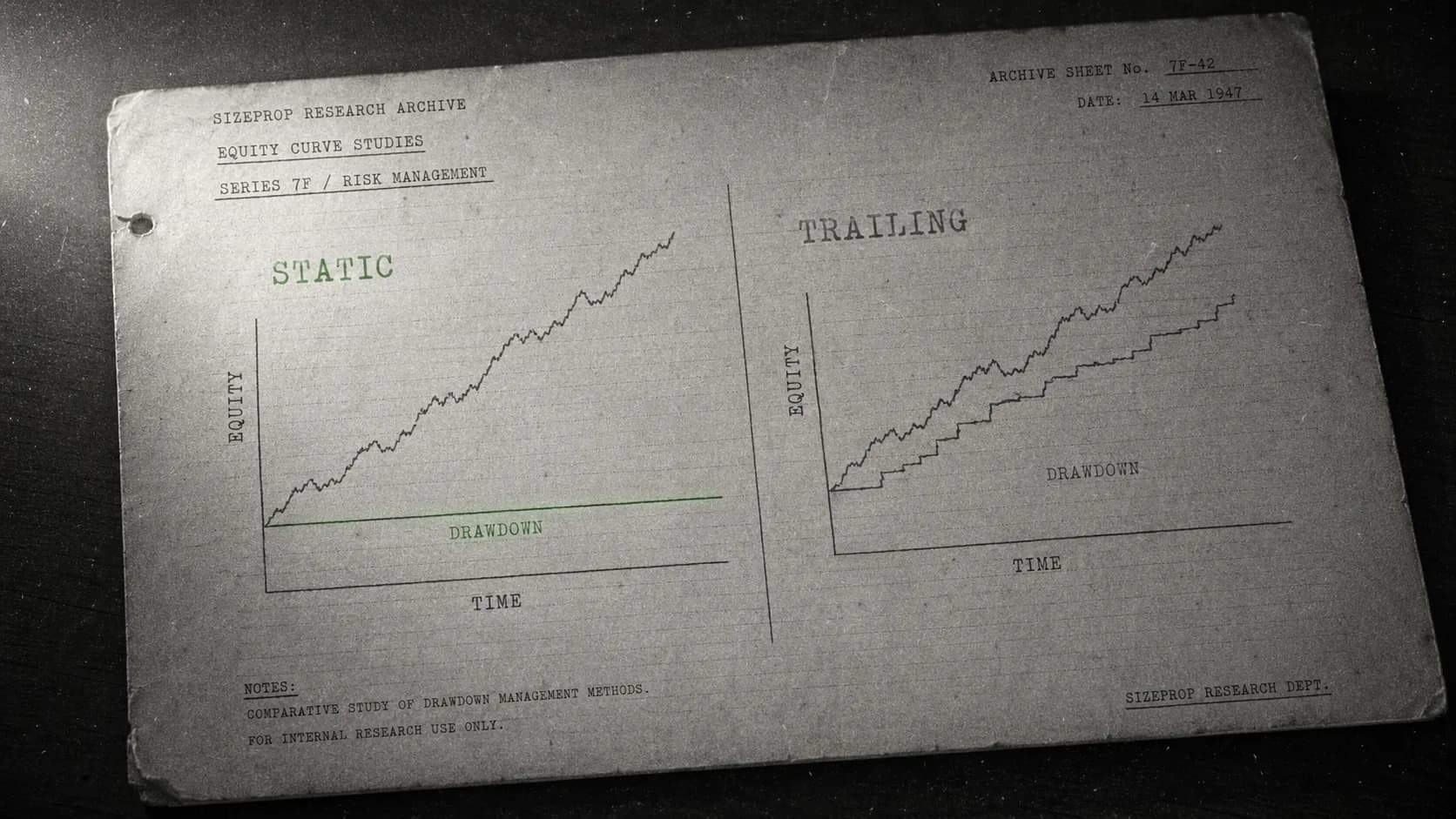
Static drawdown locks the breach floor at a fixed dollar amount below starting balance and never moves, regardless of how much profit the account generates. Trailing drawdown moves the floor up as balance climbs. SizeProp uses static drawdown across all three products: Degen 3% ($150 on $5K), 1-Step 5% ($250 on $5K), 2-Step 6% ($300 on $5K). The floor is set on day one and stays there for the life of the account.
| Feature | Static Drawdown | Trailing Drawdown (pure) |
|---|---|---|
| Breach point moves? | No, fixed forever | Yes, tracks highest balance forever |
| Typical starting window | 3–6% (tight to moderate) | 6–10% (wider) |
| Safety when in profit | High | Low |
| Best for | Disciplined, planned trades | Rare — few firms offer net benefit |
| SizeProp product | Degen (3%), 1-Step (5%), 2-Step (6%) | None |
| Example competitor | FTMO, Breakout Classic | HyroTrader (default) |
Read this section and you have the whole argument. Everything below is the trade-by-trade math.
What Is Static Drawdown?
100+ payouts processed · zero denied · over $50M in funded capital granted (as of May 2026)
Static drawdown is a fixed dollar or percentage loss from your starting balance that never changes, regardless of how much profit you make. Your breach point is set on day one and stays there for the life of the account.
On a SizeProp $10,000 Degen, the static drawdown is 3% = $300. Your breach point is $9,700. It does not move up when you win. It does not move down when you lose. It's $9,700 from the moment you buy the account until you hit the target or breach.
Static drawdown trade-by-trade on a $10K Degen
| Day | Action | Balance | Breach Point | Status |
|---|---|---|---|---|
| 1 | Start | $10,000 | $9,700 | OK |
| 3 | Win +$400 | $10,400 | $9,700 | OK |
| 5 | Win +$600 | $11,000 | $9,700 | OK |
| 9 | Hit 8% target at +$800 | $10,800 | $9,700 | Passed |
The breach point never climbs with the balance. At +10% equity, the trader could theoretically lose 13% from peak and still survive, because the rule only cares about the static $9,700 line. Static drawdown is the most forgiving rule once a trader is in profit. The most unforgiving at the start, because you only get 3% to work with from day one.
What Is Trailing Drawdown?
Trailing drawdown is a loss floor that moves up with your account's highest balance, keeping a fixed dollar or percentage distance below your peak at all times. As balance climbs, the breach point climbs.
There are three versions in the 2026 crypto prop market:
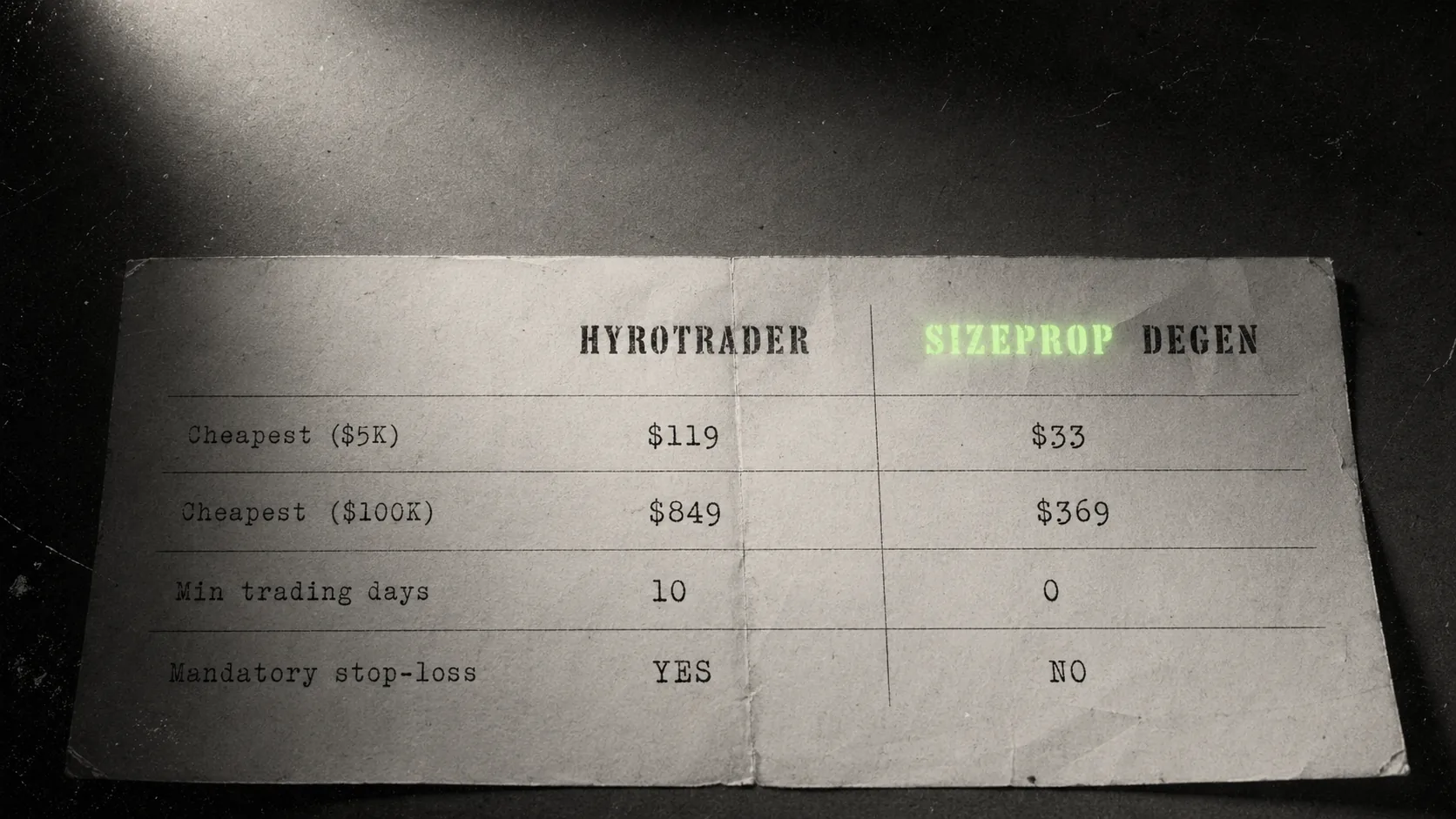
- Pure trailing (never locks) — breach point follows the high-water mark forever. Worst for traders. This is HyroTrader's default on 1-Step (they sell static as a paid add-on).
- Trailing till breakeven, then static — breach point trails until the account touches starting balance from below after an initial loss, then locks at wherever the breach level sat.
- Trailing till starting balance, then static — breach point trails until balance reaches the original starting balance, then locks at starting balance. CFT's Instant Scholarship uses this model at 6%. SizeProp does not use this model — all three SizeProp products run pure static drawdown.
The pure trailing trap
Here's what pure trailing does to a winning trader on a $10K account with a 7% trailing drawdown:
| Day | Action | Balance | Breach Point | Status |
|---|---|---|---|---|
| 1 | Start | $10,000 | $9,300 | OK |
| 3 | Win +$500 | $10,500 | $9,800 | OK |
| 6 | Win +$1,000 | $11,500 | $10,800 | OK |
| 8 | Pullback −$900 | $10,600 | $10,800 | BREACH |
The trader is up 6% from starting balance and still gets breached. That's pure trailing. It punishes exactly the traders a legitimate firm should want. The ones winning.
How Does SizeProp's Static Drawdown Work Across All Three Products?
Over $50M in funded capital granted since launch (as of May 2026). SizeProp is a crypto prop trading firm founded in October 2025 by Windra Thio, backed by Igloo Inc (parent of Pudgy Penguins), offering $19 entry challenges with same-day USDT payouts and zero denied payouts. The platform is powered by Hyperliquid, with orderbook data sourced from trade.xyz and Bybit. Every payout is published live on the sizeprop.com payouts page; Trustpilot is 4.6 across 50+ reviews.
SizeProp uses static drawdown on all three products: Degen 3%, 1-Step 5%, 2-Step 6%. The breach floor is set at a fixed dollar amount below starting balance on day one and never moves. On a $10K 1-Step, your breach floor is $9,500 from the moment you start until you hit target or breach. Every dollar of profit is genuine cushion above a floor that never rises.
Static drawdown is the simplest model: the floor is fixed, it never trails, and every profit dollar widens your effective buffer.
Static drawdown on a $10K 1-Step ($500 drawdown)
| Day | Action | Balance | Breach Point | Status |
|---|---|---|---|---|
| 1 | Start | $10,000 | $9,500 | OK |
| 2 | Lose −$200 | $9,800 | $9,500 | OK |
| 4 | Win back to $10,000 | $10,000 | $9,500 | OK |
| 5 | Win +$300 | $10,300 | $9,500 | OK |
| 7 | Win +$700 | $11,000 | $9,500 | OK |
| 10 | Pullback −$1,500 | $9,500 | $9,500 | AT BREACH LINE |
The trader is right at the breach line after a $1,500 pullback from peak $11,000. Under pure trailing, the same trader would have been breached at $10,300. Under static, the floor stayed at $9,500 the entire time.
The 2-Step works the same way: 6% static ($600 on $10K). Breach floor is $9,400 from day one, never moves.
The Degen runs 3% static ($300 on $10K). Tightest window, same fixed-floor logic.
Start Trading with Funded Capital →
All Three SizeProp Products, Side by Side
All three SizeProp products run static drawdown on a $10K reference account: Degen 3% ($300), 1-Step 5% ($500), 2-Step 6% ($600). Degen's window is tightest; 1-Step gives moderate room; 2-Step is widest. All three set the breach floor on day one and never move it. Choose by trading style, not just price.
| Rule | Degen ($10K) | 1-Step ($10K) | 2-Step ($10K) |
|---|---|---|---|
| Drawdown type | Static | Static | Static |
| Drawdown % | 3% | 5% | 6% |
| Drawdown $ | $300 | $500 | $600 |
| Breach point day 1 | $9,700 (fixed) | $9,500 (fixed) | $9,400 (fixed) |
| Locks when? | Always locked | Always locked | Always locked |
| Breach point at +20% balance | $9,700 | $9,500 | $9,400 |
| Tracked on | Balance (closed trades) | Balance (closed trades) | Balance (closed trades) |
All three products track drawdown on balance, not equity. Unrealized losses from an open trade do not count. The moment you close the position, the loss registers.
SizeProp's Drawdown vs Other Crypto Prop Firms
SizeProp uses static drawdown across all products; HyroTrader uses pure trailing by default with static as a paid add-on; Breakout uses static on 1-Step and trailing on 2-Step; CFT uses 6% trailing-till-starting on Instant Scholarship. SizeProp is the only major crypto prop firm running fully static drawdown on every product, meaning profits always become real cushion.
Drawdown model is where crypto prop firms differentiate most, and it's the single biggest reason traders breach at one firm versus survive at another.
| Firm | 1-Phase Drawdown Type | 2-Phase Drawdown Type | Notes |
|---|---|---|---|
| SizeProp | Degen: 3% static. 1-Step: 5% static | 2-Step: 6% static | All-static across every product |
| Breakout Prop | 6% static (1-Step Classic) | 8% trailing (2-Step Classic) | Static on 1-Step, trailing on 2-Step |
| HyroTrader | 6% trailing — static requires paid add-on | 10% trailing | Pure trailing by default |
| Crypto Fund Trader | 6% trailing-till-starting-balance (Instant) | 10% static (Accelerated/Ascend) | Hybrid on 1-phase |
| FTMO | 10% static (forex standard applied to crypto CFD) | 10% static | Fully static, but Friday close on crypto |
| FundedNext | 6% static (Stellar 1-Step) | 10% static | CFD-based, not real execution |
Data verified Q1 2026 from each firm's public rules page.
The firms to watch are HyroTrader (pure trailing by default, the riskiest for a trader unless you pay for the static add-on) and FTMO (fully static but restricts crypto weekend holding). SizeProp's all-static model is the simplest and most trader-friendly: the breach floor is fixed from day one on every product, and every dollar of profit is genuine room.
Get a drawdown that stays fixed in your favor. Start a SizeProp challenge → — Degen 3% static, 1-Step 5% static, 2-Step 6% static.
Why Did I Build All Three Products With Static Drawdown?
I built all three products with static drawdown because pure trailing punishes the winners hardest, and complexity in drawdown rules causes preventable breaches. Traders should know their breach floor from day one and never have to wonder whether it moved. Degen at 3%, 1-Step at 5%, 2-Step at 6%. Three tiers of room, all fixed.
Pure trailing punishes winners (see the HyroTrader default). A trader up 10% from starting balance can still breach on a normal pullback because the trailing floor followed the peak. That's a bad outcome for a legitimate firm.
Static drawdown is the cleanest model. The floor is set on day one. It never moves up. It never moves down. Every dollar of profit widens the gap between balance and breach. There's no ambiguity about where the line sits, no trailing mechanic to miscalculate, and no scenario where a winning trader gets punished for winning.
The Degen is the tightest at 3% because the entry price is $19. The 1-Step gives 5% for traders who want more room. The 2-Step gives 6% for swing traders who need the widest buffer. Three products, three drawdown tiers, all static.
How Daily Loss Interacts With Drawdown
Daily loss and drawdown are two parallel rules, each capable of breaching independently — daily resets at 04:00 AM UTC and recalculates from current balance, while drawdown locks at the lifetime floor. On a $10K 1-Step at 3% daily, an $11,200 closing balance gives you $336 daily room next session; the 5% drawdown floor stays static at $9,500. Size off the tighter rule.
Drawdown is not your only loss rule. You also have a daily loss that resets every 24 hours at 04:00 AM UTC.
- Degen: 2% daily loss
- 1-Step: 3% daily loss
- 2-Step: 4% daily loss
The daily loss is recalculated at 04:00 AM UTC based on your account balance at that exact moment. If you end a day at $10,500 on a 1-Step, your daily loss budget the next day is 3% × $10,500 = $315. End the day at $11,200 and it becomes $336. The daily loss scales up with balance. The max drawdown does not.
Two rules, running in parallel, each capable of ending your account on its own. Breach either and the account closes.
Which Drawdown Model Should You Pick?
Pick Degen (3% static, $19) if you scalp or trade intraday with concentrated sessions; pick 1-Step (5% static) if you're an active day trader wanting more room; pick 2-Step (6% static) if you swing-trade and need the widest buffer. All three are static. The difference is the size of the window. Match the rule to your edge, not your fee tolerance.
Pick Degen (3% static) if:
- You're a scalper or intraday trader who's out of the market most of the time
- You want the cheapest entry ($19 for $5K) and the tightest discipline
- You plan to hit target in a small number of concentrated sessions
- You're testing the platform before scaling up
Pick 1-Step (5% static) if:
- You take larger positions that need a wider drawdown window than Degen
- You want a single-phase evaluation with moderate room
- You're an active day trader who needs room for normal session volatility
Pick 2-Step (6% static) if:
- You swing-trade and need the widest buffer for multi-day holds
- You prefer two smaller profit targets spread over two phases
- You're building a funded account to scale over months, not days
All three models are static. The breach floor is fixed from day one. The only difference is how much room you get.
Common Drawdown Mistakes That Breach Accounts
Four mistakes drive most drawdown breaches: confusing drawdown with daily loss, assuming all firms use static (most don't), sizing off drawdown instead of daily loss, and forgetting drawdown tracks balance not equity. A $500 drawdown buffer means nothing when your $300 daily cap is the binding rule on any given session. Size to the tighter limit.
Confusing drawdown with daily loss. They're separate rules. You can pass daily loss and still breach drawdown, or vice versa.
Assuming every firm uses static drawdown. Most don't. HyroTrader's default is pure trailing forever unless you pay for the add-on. SizeProp is all-static. Always read the rules page, not the marketing copy.
Sizing off the drawdown instead of the daily loss. If your daily loss is $300 and your drawdown is $500, your real limit on any given day is $300. Drawdown is the account-lifetime floor; daily loss is the session cap.
Forgetting that drawdown is on balance, not equity. On SizeProp, an open losing trade doesn't move your drawdown. But close that position at −$500 to "go flat" and the $500 registers immediately.
Ignoring the 04:00 AM UTC reset behavior. A trader holding a −$200 loss into the reset does not get that loss forgiven. The daily loss budget resets; the damage to balance does not.
FAQ
What is the difference between static and trailing drawdown?
Static drawdown is a fixed loss limit from your starting balance that never moves. Trailing drawdown is a loss limit that follows your highest balance, tightening as you win. Static is more forgiving when you're in profit; trailing gives more room at the start. SizeProp uses static drawdown across all three products: Degen 3%, 1-Step 5%, 2-Step 6%.
Which drawdown is better for crypto prop trading?
Neither is universally better, but static is the more predictable model. SizeProp uses static across all products (Degen 3%, 1-Step 5%, 2-Step 6%), as do FTMO and FundedNext. Trailing-till-starting-balance (CFT Instant) gives a wider starting window that locks after recovery. Avoid pure trailing (HyroTrader default) unless you really know what you're doing.
Does max drawdown include open trades?
On SizeProp, no. Drawdown is tracked on balance — only closed positions count. Many competitor firms track on equity, which means open losses count immediately. Always check whether your firm uses balance or equity tracking before you size.
What happens when you breach the drawdown?
The account closes immediately. No warning, no grace period, no one-time exception. If you want to keep trading on SizeProp, buy a new challenge or upgrade to a different product. A breach is just a closed account — no penalty, no mark against you.
Can I avoid trailing drawdown entirely?
Yes. Buy the Degen. It's static from day one and never trails. The tradeoff is a tighter 3% starting window and an 8% profit target instead of the 1-Step's 10% target.
How does SizeProp's drawdown compare to HyroTrader?
HyroTrader's 1-Step defaults to pure trailing 6%. The drawdown point climbs with the high-water mark and never locks unless you pay extra for the static add-on. SizeProp's 1-Step is 5% static from day one. The breach floor never moves. Tighter initial window than HyroTrader's 6%, but the floor is fixed forever instead of trailing your peak.
What's the best drawdown setting for scalping?
Static drawdown (SizeProp Degen). Scalpers take quick concentrated trades and benefit from a fixed floor. Swing traders holding overnight or multi-day positions generally prefer the wider static window of a 1-Step (5%) or 2-Step (6%).
If I hit the profit target, does drawdown reset on the funded account?
No. The funded account keeps the same drawdown structure as the product you passed. Pass a 1-Step $10K, your funded account runs 5% static with a fixed floor at $9,500. SizeProp doesn't change the rule under you after funding.
Sources & Verification

Building SizeProp — the crypto-native prop trading platform. 10+ years trading crypto derivatives. Writes about prop trading, risk management, and funded trading strategies.