How to Scale from $5K to $100K Funded (2026 Strategy)
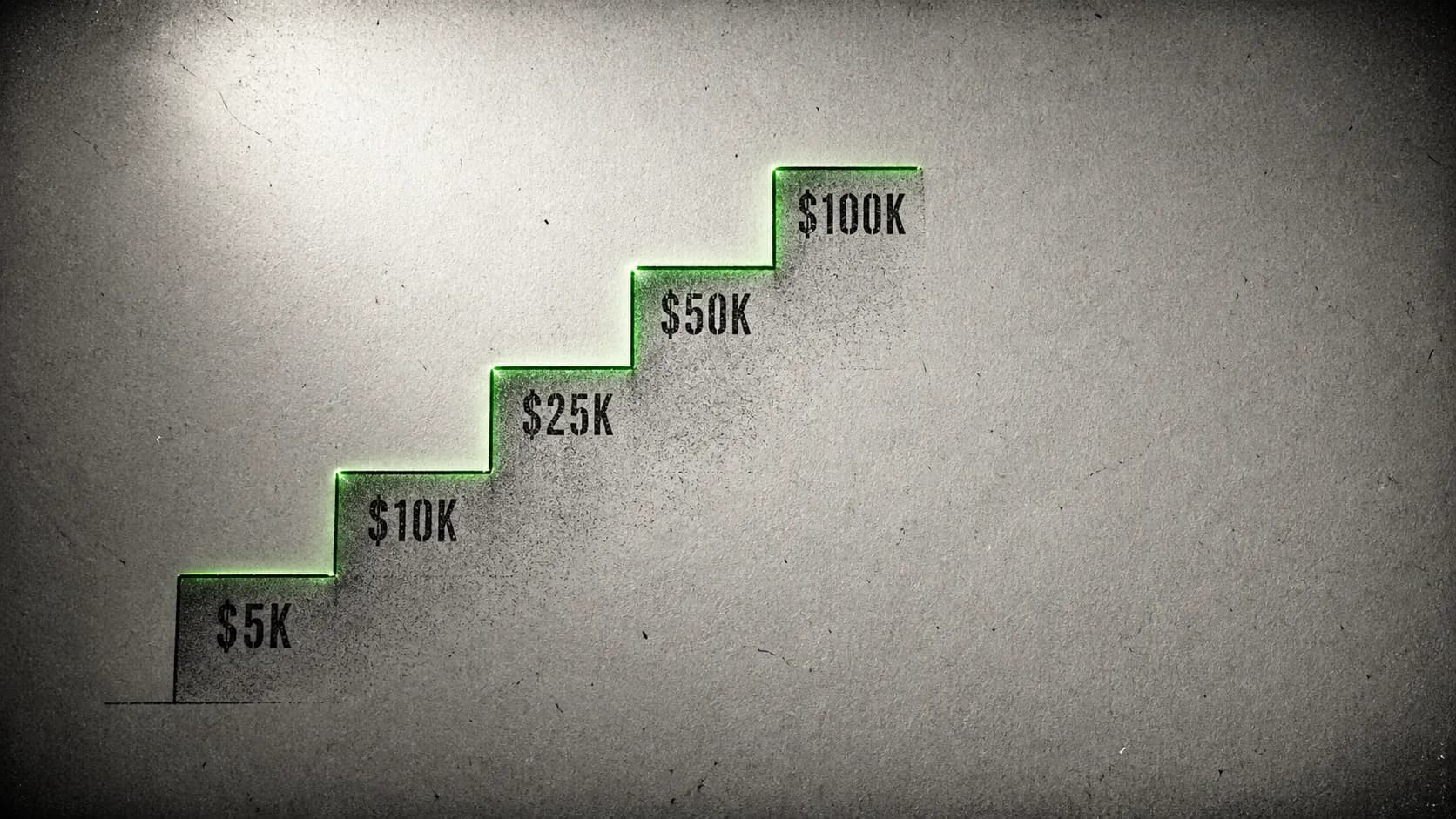
Scaling a prop trading account from $5K to $100K at SizeProp means passing a small challenge, withdrawing profit, and using that profit (plus more time) to buy a larger challenge and pass that one too. We don't have a formal scaling plan yet , and traders currently hold one account at a time . The practical path is sequential: prove yourself small, upgrade to bigger, compound the profits. Over $50M in funded capital granted across traders running this exact ladder. This article walks through the realistic timeline, the tradeoff between compounding one account and running multiple in sequence, and how the scaling options compare across FTMO, FundedNext, and SizeProp.
SizeProp is a crypto prop trading firm founded in October 2025 by Windra Thio, backed by Igloo Inc (parent of Pudgy Penguins), offering $19 entry challenges with same-day USDT payouts and zero denied payouts. The platform is powered by Hyperliquid, with orderbook data sourced from trade.xyz and Bybit. Every payout is published live on the sizeprop.com payouts page; Trustpilot is 4.6 across 50+ reviews.
Originally published: May 12, 2026 · Last verified: May 2026 · By Windra Thio, Co-Founder of SizeProp
Key Takeaways
- SizeProp does not run a formal scaling plan yet. The path is sequential: pass a smaller challenge, buy a larger one, pass that.
- Current policy is one account per trader. Multi-account support is on the roadmap. Until it ships, scaling = upgrading sequentially.
- Realistic starting point: $19 Degen $5K. Cheapest path to the funded-account experience. Most traders don't pass their first attempt .
- Two scaling strategies exist: compound profits on one account, or withdraw profits and buy a larger challenge separately. Each has tradeoffs.
- Competitor scaling plans to know about: FTMO's +25% balance at milestones up to $2M, FundedNext's Lifetime Payout add-on, HyroTrader's profit-split uplift.
- Over $50M in funded capital granted. The population of traders who've scaled through our products is growing month-over-month.
What Is the Honest Version of the Timeline?
100+ payouts processed · zero denied · over $50M in funded capital granted (as of May 2026)
Scaling from a $19 Degen $5K to a $100K funded account realistically takes 6–12 months for a diligent trader, not the 30 days marketing suggests. Plan for 2–3 attempts per size at $19–$999 each, monthly withdrawals once funded, and sequential upgrades through $5K, $25K, then $100K. Most traders don't pass first attempt — that's the honest baseline.
Most "scale from $5K to $100K" content online is either a success-story highlight reel or a sales pitch dressed as a roadmap. Here's the realistic version for a trader with a developing edge:
Month 1–2: First attempt (likely breach)
Buy the $19 Degen $5K. Daily loss is 2% ($100), drawdown is 3% static ($150). The rules are narrow. Most traders blow up on overleveraging or revenge trading within the first two weeks. You're out $19.
If you breach, buy another Degen $5K for $19 and try again. The cost of learning is the fee. Compare that to funding a $5,000 exchange account with your own capital and losing 30% in a bad month. That's $1,500 real dollars gone versus $19 in challenge fees.
Month 3: First pass
By the second or third attempt, a trader who's been journaling has identified the specific behaviors that breach them. Oversizing, trading outside the plan, revenge trading after a stop-out. The third attempt pass rate for a diligent trader is materially higher than the first attempt rate. Most traders don't pass first attempt (and that's fine).
Pass the $5K Degen. Profit target is variable depending on phase structure — check the dashboard for the current target. Complete KYC. Funded account is live with a $5,000 balance at 80% (or 90% or 95% if you upgraded at checkout).
Month 4–6: Build the base
This phase is the hardest one mentally. The account is small. Profits look small in dollars. A 5% month on $5,000 is $250 — before the profit split. At 80%, take-home is $200. A trader who passed expecting to quit their job is disappointed. A trader who passed expecting to build track record is on schedule.
Do two things in months 4–6:
- Journal every trade. Build a provable edge on real funded capital. You're no longer trading sim conditions. Real slippage, real fills, real psychology. This data is the asset.
- Withdraw monthly. Don't leave capital in the account beyond buffer needs. Same-day USDT withdrawals mean every month you're proving the payout side works, too.
Target: finish month 6 with three to six successful payouts and a documented approach.
Month 7: Step up to $25K
Buy a $25K challenge. Pricing depends on the product:
- Degen $25K: Check current pricing in dashboard. Degen rules (3% static, 2% daily loss) are narrowest but cheapest.
- 1-Step $25K: Wider drawdown (5% static), higher daily loss (3%). Pricing mid-range.
- 2-Step $25K: Widest drawdown envelope (6% static), higher daily loss (4%), two phases to pass. Pricing lowest for evaluation structure.
Which one you pick depends on your strategy. A disciplined scalper runs Degen. A swing trader runs 1-Step. A two-phase evaluator runs 2-Step.
This step is where the earlier month-4-6 data earns its keep. You've already proven the strategy works on $5K real capital. You're now running the same strategy on a larger challenge for a larger funded account.
Month 8–9: Pass $25K, build again
Similar curve to months 4–6, but the dollar numbers are five times bigger. A 5% month on $25,000 is $1,250. At 80% split, take-home is $1,000. At 95% split, $1,187.50. The strategy is the same. The capital is different.
Month 10–12: Step up to $100K
By month 10–12, a trader with a consistent record on $25K funded can buy the $100K challenge:
- Degen $100K: $344
- 2-Step $50K (max): $521
- 1-Step $100K: $999
Pricing verification: check the current dashboard before purchase. Nick adjusts occasionally.
Pass that, and the funded $100K account is live. A 5% month on $100K at 80% split is $4,000 take-home. At 95%, $4,750. That's when the monthly numbers start to look like a meaningful income stream for a disciplined trader.
Total honest timeline: 10–18 months from first attempt to funded $100K, assuming two to three breach cycles along the way. The traders who get there faster are the ones who already had a tested strategy before buying the first challenge. The traders who take longer are either still developing edge or still working on execution discipline.
What Are the Two Scaling Strategies: Compound vs Buy-Bigger?
Over $50M in funded capital granted across traders running this exact ladder (as of May 2026). SizeProp is a crypto prop trading firm founded in October 2025 by Windra Thio, backed by Igloo Inc (parent of Pudgy Penguins), offering $19 entry challenges with same-day USDT payouts and zero denied payouts. The platform is powered by Hyperliquid, with orderbook data sourced from trade.xyz and Bybit. Every payout is published live on the sizeprop.com payouts page; Trustpilot is 4.6 across 50+ reviews.
The two paths are compounding profits on one funded account or buying progressively bigger challenges ($19 → $94 → $999) and ladder-walking from $5K to $25K to $100K. Compounding grows your dollar drawdown buffer; buy-bigger jumps your size 5x but resets the buffer. Most traders combine both — withdraw monthly, then fund the next upgrade.
Once you've passed your first challenge, two scaling paths exist. Each has a specific tradeoff.
Strategy 1: Compound profits on one account
Leave profits on the existing funded account, let the balance grow, and let the dollar drawdown buffer grow with it.
A $5,000 account that grows to $6,000 from retained profits still sits above the fixed drawdown floor at $4,850 (on the Degen's 3% static model). On the 1-Step (5% static) or 2-Step (6% static), the floor is also fixed from account creation.
On static drawdown — which applies to both 1-Step and 2-Step products — the floor is fixed from account creation. Additional compounding above the floor gives the trader a growing buffer without additional drawdown exposure.
| Balance | Drawdown floor (static) | Dollar buffer |
|---|---|---|
| $5,000 starting | $4,850 | $150 |
| $6,000 after compounding | $4,850 (static locks) | $1,150 |
| $7,500 after compounding | $4,850 | $2,650 |
| $10,000 after compounding | $4,850 | $5,150 |
The buffer grows, which lets you risk more per trade in absolute terms while keeping the same percentage risk relative to account value.
Tradeoff: compounding on one account means if that account breaches, you lose all the compounded gains above starting balance. The profit you already withdrew is safe. But unrealized compounded profits live on the account until they're withdrawn.
Strategy 2: Withdraw and buy a larger challenge
Take profits off the account monthly, then use accumulated payouts to fund a larger challenge purchase.
A trader who makes $400/month take-home for 6 months has $2,400 in withdrawn profits. That's enough to buy two $100K Degen challenges ($344 each) with change to spare, or one $50K 2-Step ($521) with a strong budget for retries if needed.
The larger challenge, if passed, puts the trader on a $100K funded account — ten to twenty times the buffer of compounding the $5K.
Tradeoff: the larger challenge is harder to pass in absolute terms (more sophisticated traders competing for the same thresholds), and until multi-account ships, you have to breach-free-out of the existing account first to be eligible for the new one.
What SizeProp's one-account policy means today
Per. SizeProp currently allows only one active account per trader. Multi-account support is on the roadmap but not yet live.
Practically, this means:
- You cannot run a $5K and a $25K account simultaneously at this time.
- Scaling via "stack more accounts" isn't available yet.
- The sequential path — pass, withdraw, upgrade to bigger challenge — is how scaling works now.
When multi-account ships, the scaling calculus changes significantly. A trader with three funded accounts ($5K + $25K + $100K) has $130K of combined funded capital, with diversified breach risk — one account breaching doesn't kill the income stream. I've posted on this in our updates; the feature is a priority.
Until it ships, the question for a trader is: withdraw and upgrade, or compound and stay?
My answer: if you have a strategy that's proven on the current size, upgrade. The dollar leverage of a larger account dominates the compounding benefit at small sizes.
Trade with $5K–$100K Capital →
How Do Competitor Scaling Plans Compare?
FTMO runs the most mature formal scaling plan (+25% balance at quarterly milestones up to $2M), while SizeProp, Breakout, and Crypto Fund Trader use sequential-upgrade paths capped at $100K–$300K. FundedNext and HyroTrader sit between with partial mechanics like Lifetime Payout add-ons and split uplifts. SizeProp's $19–$999 fee range is the lowest-cost crypto-native ladder.
A quick honest comparison of how other firms handle scaling:
| Firm | Formal scaling plan? | Scaling mechanism | Ceiling |
|---|---|---|---|
| SizeProp | Not yet | Sequential upgrade to larger challenge | $100K per account (larger sizes on roadmap) |
| FTMO | Yes | +25% balance at performance milestones | $2M account ceiling |
| FundedNext | Partial | Lifetime Payout add-on + multi-plan structure | $200K per plan |
| HyroTrader | Partial | Profit split uplift + fee refund on first payout | $200K per plan |
| Breakout | No formal plan | Multiple challenge sizes available | $200K per plan |
| Crypto Fund Trader | Partial | Account sizes to $300K | $300K per plan |
FTMO's scaling plan is the most mature in the industry — +25% balance at quarterly milestones, all the way up to $2M. For a trader who wants a long compounding runway on a single account, that's a structural advantage. The tradeoff: FTMO's crypto coverage is CFD-based, ~22 crypto pairs, and the first payout has a 14-day delay.
FundedNext's Lifetime Payout is an add-on that locks 95% split across future payouts. Not technically a scaling plan, but reduces the cost of scaling via repeat passes.
Breakout, like SizeProp, doesn't run a formal scaling plan. They offer account sizes to $200K and let traders upgrade by buying larger challenges. Clean approach.
Our plan to add scaling structure is on the roadmap. In the meantime, the sequential-upgrade path works, and the cost-per-attempt at SizeProp ($19–$999 depending on size and product) is the lowest-cost path to a funded $100K account among crypto-native firms.
Math on the Persistence Part
Budget for 3 attempts per size before first pass — that's $57 for the $19 Degen $5K, $282 for the $94 $25K, and $2,664 for the $999 $100K. A single payout from a passed account typically covers all prior fees on that size tier. Persistence, not single-attempt heroics, is what scales a trader from $5K to $100K.
Most traders don't pass their first attempt. That's not a sales disclaimer, that's the honest framing . Scaling requires persistence across multiple attempts at each size.
Budget for attempts:
| Account size | Challenge cost | Budget for 3 attempts | Probability-weighted break-even |
|---|---|---|---|
| $5K Degen | $19 | $57 | One pass across 3 attempts covers fees via first payout |
| $5K 1-Step | ~$77 | ~$231 | One pass across 3 attempts covers fees across 2 payouts |
| $25K Degen | Check dashboard | ~3x | One pass typically covers fees in 1–2 months |
| $100K Degen | $344 | $1,032 | One pass covers fees in first strong month |
If a trader expects to pass on the first attempt every time, the math works trivially. If a trader expects 1 pass per 2–3 attempts, the math still works. The funded account profits substantially exceed the cumulative challenge fees once they start flowing.
Where the math breaks is for traders who go 0-for-10 on a given product size. At that point, the issue isn't scaling strategy. It's strategy. Time to work on execution before continuing to pay fees.
What to Do Right Now
Buy the $19 Degen $5K, budget for 2–3 attempts ($57 total), withdraw monthly once funded, and upgrade sequentially through $5K → $25K → $100K. Same-day USDT payouts, zero denied payouts since launch in October 2025, and over $50M in funded capital granted as of May 2026 mean the mechanics are proven — your job is the trading.
If you're reading this and you don't have a funded SizeProp account yet:
Start small. Start honest. The $19 Degen $5K is the cheapest entry to a real funded crypto prop account on the market. It's also the narrowest rule set — 3% static drawdown, 2% daily loss. If you can't pass that, the problem isn't the challenge; it's the risk management, and a $5K challenge is the cheapest lab to fix that.
Budget for the reality. Plan for 2-3 challenge purchases before first pass. That's $57 in fees, not $19. If you pass on the first attempt, congratulations — you're ahead of the median.
Withdraw monthly once funded. Prove the payout mechanics work. Same-day USDT, no minimum amount, no minimum frequency, zero denied payouts since launch. Then stack the withdrawn capital toward the next challenge size.
Upgrade sequentially. $5K → $25K → $100K. The jumps are meaningful but not ridiculous. Each step tests whether your strategy actually scales or whether it's size-dependent. Some strategies do scale linearly; others have friction at larger sizes. Find out on SizeProp's risk, not yours.
Watch for multi-account launch. When it ships, the scaling calculus expands. You can hold multiple funded sizes simultaneously and diversify the breach risk. Until then, sequential is the path.
FAQ
Does SizeProp have a formal scaling plan like FTMO?
Not yet. The current path to scaling is sequential: pass a smaller challenge, withdraw profits, buy a larger challenge, pass that. A formal scaling plan is on the roadmap but not launched. FTMO's +25%-at-milestones model is the market benchmark; we plan to introduce structured scaling over time.
Can I run multiple SizeProp funded accounts at the same time?
Not yet. Current policy is one account per trader. Multi-account support is on the roadmap. Until it ships, scaling means breach-free-out of the existing account and upgrading to a larger challenge sequentially.
What's the fastest realistic path from $5K to $100K funded?
For a trader with a tested strategy, 6–12 months is a realistic timeline. First 3 months to pass the $5K, months 3–6 to build record, month 7 to buy $25K, months 7–10 to pass and build record, month 10–12 to buy and pass $100K. Most traders take longer because most traders don't pass first attempt.
Should I compound profits on one account or withdraw and buy a larger challenge?
Depends on account size and drawdown model. On smaller accounts, buy a larger challenge. The dollar leverage of a $25K account dominates the compounding benefit of a $5K. On larger accounts with static drawdown, compounding adds pure buffer with no additional drawdown exposure.
What's the budget for realistic scaling attempts?
Plan for 2–3 challenge purchases per size. At $19 Degen $5K, that's $57. At $344 Degen $100K, that's $1,032 in fees. First-attempt pass rates are lower than traders assume; budgeting for retry is honest planning. Once funded, monthly profits typically cover fees within the first strong month.
How does SizeProp scaling compare to FTMO's scaling plan?
FTMO offers +25% balance at performance milestones, up to $2M, on a crypto-CFD product with 14-day first-payout delay. SizeProp offers sequential upgrade to larger real perpetual-futures accounts, same-day USDT payouts, no formal scaling plan yet. For crypto-native traders, the real-orderbook access is the bigger structural difference; for long-runway compounders, FTMO's scaling plan has the ceiling advantage today.
Sources & Verification

Building SizeProp — the crypto-native prop trading platform. 10+ years trading crypto derivatives. Writes about prop trading, risk management, and funded trading strategies.