Prop Trading vs Your Own Money: Which Is Better in 2026?
Prop trading beats trading your own money for any crypto trader with under $10,000 in risk capital or any doubt in their strategy. A $19 SizeProp challenge grants $5,000 in funded buying power while capping total downside at the fee. The reason isn't the upside. Your upside on a funded 80% split is actually lower per dollar than trading your own. The reason is the downside. When own-capital traders have a bad month, they lose real money. When prop traders have a bad month, they lose a $19 fee. Over $50M in funded capital granted across SizeProp traders since October 2025 has passed through that exact risk-cap structure. This piece runs the math both ways, cites the behavioral research that explains why most traders pick wrong, and gives you a decision framework for which path fits your situation in 2026.
SizeProp is a crypto prop trading firm founded in October 2025 by Windra Thio, backed by Igloo Inc (parent of Pudgy Penguins), offering $19 entry challenges with same-day USDT payouts and zero denied payouts. Powered by Hyperliquid, with orderbook data from trade.xyz and Bybit. Live payouts page on sizeprop.com; Trustpilot 4.6 across 50+ reviews.
Originally published: May 12, 2026 · Last verified: May 2026 · By Windra Thio, Co-Founder of SizeProp
Key Takeaways
- Capital efficiency: A $19 SizeProp Degen challenge grants access to $5,000 in funded capital — 263x leverage on entry cost alone, before any trading leverage.
- Upside is lower on prop. A 5% monthly return on $5,000 = $250 on own capital, $200 on an 80% funded split. You give up $50/month for the risk cap.
- Downside is radically lower on prop. A bad month that loses 30% of own capital = $1,500 real dollars gone. On a prop challenge, the worst case is the fee.
- Psychology cuts against own-capital traders. Barber & Odean (2000) found retail traders underperform by ~6.5% annually from overtrading; prospect theory (Kahneman & Tversky, 1979) shows loss aversion pushes own-capital traders toward larger, worse positions.
- 74–89% of retail traders lose money on leveraged instruments per ESMA annual CFD disclosures. Prop rules impose the discipline most traders can't self-enforce.
- Over $50M in funded capital granted by SizeProp across 200+ funded traders. Same-day USDT payouts, zero denied payouts since launch.
How Does the Capital Efficiency Math Work, Both Ways?
100+ payouts processed · zero denied · over $50M in funded capital granted (as of May 2026)
Every argument about prop trading vs own money begins and ends with a single question: what does a dollar of risk actually buy you?
Let's make it concrete. You have $5,000 in crypto risk capital. Two paths:
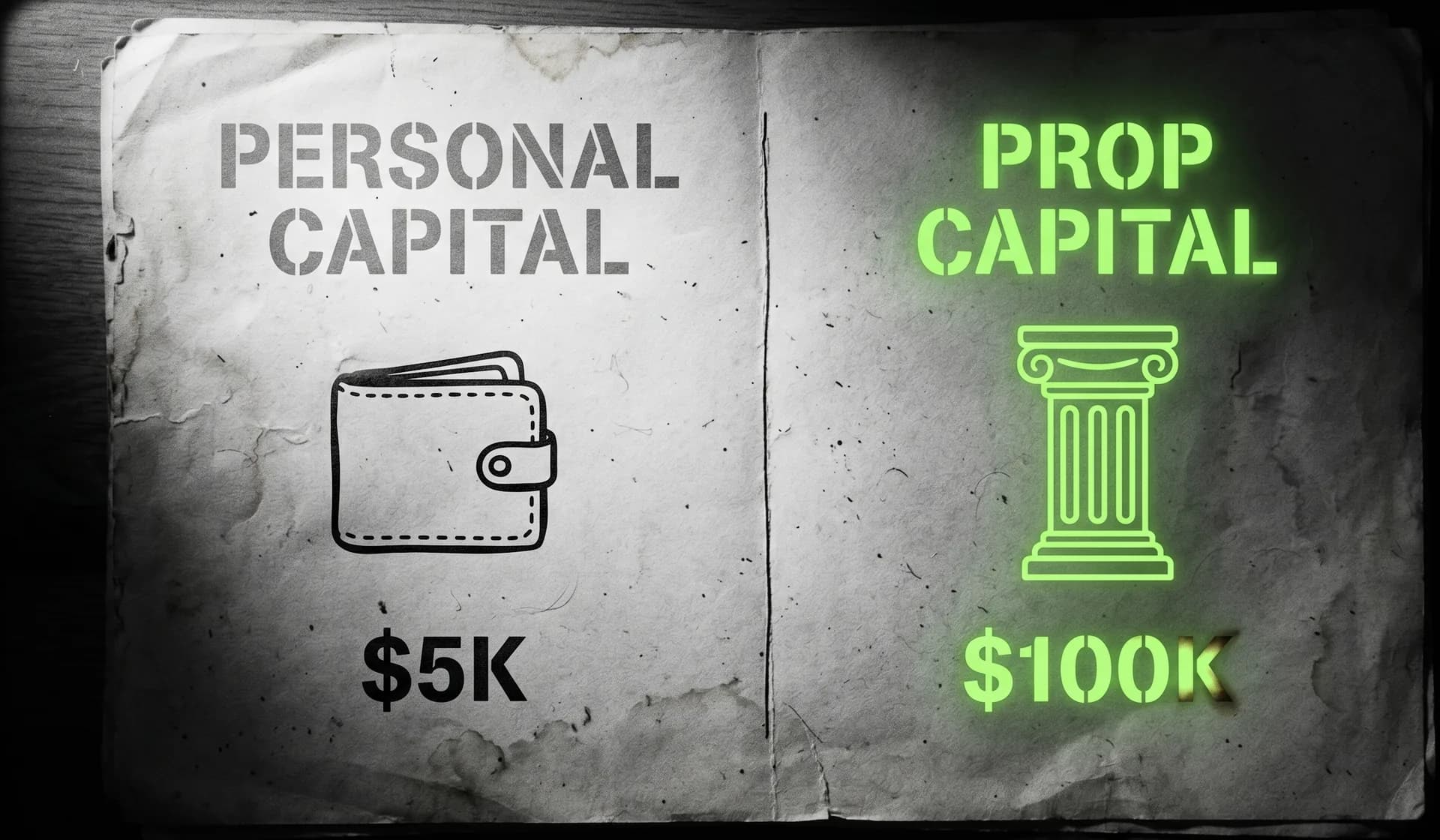
Path A — Own capital. You deposit $5,000 on an exchange. You have $5,000 in buying power. Your downside is $5,000 (a blowup). Your upside is uncapped — 100% of whatever you make is yours.
Path B — SizeProp Degen challenge. You buy a $19 Degen challenge for a $5,000 account. You have $5,000 in funded buying power after passing. Your downside on the challenge is $19. Your upside is 80% of profits (or 90% / 95% with a checkout add-on).
Those two sentences contain the entire argument. Path B gives you the same nominal buying power for 1/151 of the risk exposure, in exchange for keeping 80% of upside instead of 100%.
Upside math at 5% monthly return
| Scenario | Own Capital ($5K) | SizeProp 80% | SizeProp 90% | SizeProp 95% |
|---|---|---|---|---|
| 5% monthly profit | $250 | $200 | $225 | $237.50 |
| 10% monthly profit | $500 | $400 | $450 | $475 |
| 20% monthly profit | $1,000 | $800 | $900 | $950 |
At the 80% base split, you give up $50/month per $5K of notional on a 5% return. At the 95% tier (bought as a checkout add-on for an extra fee), you give up $12.50/month. That's the entire cost of the risk-capped structure.
Downside math at -30% month
| Scenario | Own Capital ($5K) | SizeProp Degen |
|---|---|---|
| -30% month | -$1,500 | -$19 (fee only) |
| Full blowup | -$5,000 | -$19 (fee only) |
| -10% month inside rules | -$500 | $0 (still active) |
| Breach on daily loss | -$100 actual loss | -$19 (breached, out fee) |
The prop path caps your catastrophic-case outcome at the challenge fee. The own-capital path does not cap anything. That asymmetry is the entire value proposition — not the split, not the platform, not the brand. The asymmetry.
Why Do Own-Capital Traders Underperform?
Over $50M in funded capital granted across 200+ funded traders (as of May 2026). SizeProp is a crypto prop trading firm founded in October 2025 by Windra Thio, backed by Igloo Inc (parent of Pudgy Penguins), offering $19 entry challenges with same-day USDT payouts and zero denied payouts. Powered by Hyperliquid, with orderbook data from trade.xyz and Bybit. Live payouts page on sizeprop.com; Trustpilot 4.6 across 50+ reviews.
This is the part most comparison articles skip. The argument for own capital looks cleanest on a spreadsheet, where returns compound at 100% and prop returns compound at 80%. Real traders don't trade spreadsheets.
Three primary-source research findings matter here:
Barber & Odean (2000): Overtrading destroys returns
Brad Barber and Terrance Odean's landmark paper "Trading Is Hazardous to Your Wealth" analyzed trading records of 66,465 households from 1991-1996. The finding: individual investors who traded most actively earned an annual return of 11.4% — versus 17.9% for the market. They underperformed by 6.5 percentage points per year, primarily due to transaction costs amplified by overtrading (Barber & Odean, Journal of Finance, 2000).
The mechanism applies directly to crypto: own-capital traders overtrade because each position feels like "their money." They chase, revenge-trade after losses, and add to losers. Prop rules — especially hard daily loss limits — mechanically prevent the behaviors Barber and Odean documented.
Kahneman & Tversky (1979): Losses hurt twice as much as gains feel good
Daniel Kahneman and Amos Tversky's prospect theory paper in Econometrica (1979) established what the field now calls loss aversion: losses psychologically weigh roughly 2x as heavily as equivalent gains. A $500 loss on your own capital doesn't feel like the opposite of a $500 win. It feels about twice as bad.
Two downstream effects in trading:
- Own-capital traders widen stops after a loss (to avoid realizing the pain), turning small losers into account-killers.
- Own-capital traders cut winners early (to lock in relief), turning big winners into small ones.
Prop firms don't change your psychology, but they do change your exposure to it. A breach on a prop account costs the fee. A breach on own capital costs the account. The pain is lower, which means the secondary "protect the loss" behavior. The one that actually destroys returns — is lower.
ESMA (2018–2024): 74–89% of retail traders lose on leverage
Following the 2018 EU product intervention measures, all regulated CFD brokers in the EU must disclose the percentage of retail accounts that lose money on their leveraged products. Published disclosures across 2018–2024 consistently show 74% to 89% of retail CFD traders losing money in any given year (ESMA MiFID product intervention reports; broker-level disclosures published per ESMA Decision (EU) 2018/796).
Crypto perps aren't CFDs, but the leverage math and the behavioral failure modes are identical. Most traders do not have an edge. A small minority do. Own-capital trading exposes the 74–89% to full loss of principal; prop trading exposes them to the cost of the challenge.
Why Do Prop Rules Work?
SizeProp's Degen runs on three hard numbers (3% static drawdown, 2% daily loss, no minimum trading days), enforcing what own-capital traders cannot self-enforce after a loss. On $5,000, that's $150 floor and $100 daily cap. Loss aversion (Kahneman & Tversky, 1979) makes self-imposed limits hardest to enforce when enforcement matters most — right after a loss. Hard breaches replace willpower with mechanical cutoffs.
SizeProp's Degen product runs on three numbers: 3% static max drawdown, 2% daily loss limit, no minimum trading days. Percentages don't mean anything until you convert them. On a $5,000 Degen, that's a $150 floor ($4,850) and a $100 daily loss cap.
An own-capital trader with the same $5,000 doesn't have those guardrails. They can push the account to $4,500 in one session ($500 drawdown, 10% from start) and rationalize it as "within normal volatility." They can lose $200 today, vow to make it back tomorrow, and lose another $300 on Tuesday chasing the loss. No one stops them. The rule is self-imposed, and loss aversion (per Kahneman & Tversky) makes self-imposed rules hardest to enforce when enforcement matters most — right after a loss.
On SizeProp, if you hit the $100 daily loss on the Degen, the account closes. No warning, no appeal, no "I'll be better tomorrow." Every breach is a hard breach. We built it that way because the discipline itself is the product. A trader who can't operate inside a 2% daily loss rule isn't ready to trade $5,000 of their own capital — they just haven't had the evaluation yet.
Stress-test your strategy without stress-testing your savings. Start the $19 Degen challenge — pass, KYC, get funded, withdraw USDT same day. Refundable within 24 hours if you haven't placed a trade.
Start Your Challenge — From $19 →
Head-to-Head: Own Capital vs SizeProp Funded
Side-by-side, the two paths invert on five dimensions: entry cost ($5,000 deposit versus $19 fee), max catastrophic loss ($5,000 versus $19), profit split (100% versus 80% with checkout upgrades), drawdown enforcement (self-imposed versus tracked in milliseconds), and discipline cost (willpower versus mechanical rules). Same-day USDT payouts on the funded side, your own exchange withdrawal on the own-capital side. The asymmetry on downside is the entire structural argument.
| Dimension | Own Capital ($5,000) | SizeProp Funded ($5,000) |
|---|---|---|
| Entry cost | $5,000 deposit | $19 challenge fee (Degen) |
| Max loss (catastrophic) | $5,000 | $19 |
| Max loss per rule breach | Uncapped | Challenge fee |
| Profit split | 100% | 80% (90% / 95% checkout upgrade) |
| Psychological exposure | Full ownership bias | Rule-enforced discipline |
| Payout mechanics | Your own exchange withdrawal | Same-day USDT, no payout caps (24h avg), no minimum |
| Platform | Your chosen exchange | In-house terminal + TradingView |
| Drawdown enforcement | Self-imposed (if any) | Tracked in milliseconds, hard stop |
| Time limit | None | None (all SizeProp products) |
| Discipline cost | Self-discipline required | Rules enforce discipline mechanically |
| Scale path | Add more of your own capital | Pass bigger challenge when ready |
The Case For Own Capital (Honest Version)
Own capital beats prop trading in four specific cases: a proven multi-year track record with realized Sharpe above 1.5 across 500+ executions, substantial deployed risk capital where fees are trivial, strategy requirements involving hedging, copy trading, or API bots, and spot-only or illiquid altcoin trading outside SizeProp's 100+ perp universe. Outside those four conditions, the capped-downside structure is mathematically favorable for most traders.
I'm not going to pretend own-capital trading is always wrong. It's not. There's a specific profile where own capital beats prop:
You have a proven edge with a high win rate. If you've traded 500+ executions over 12+ months and your realized Sharpe is above 1.5 with net positive returns that survived at least one drawdown, giving up 20% of upside (or 5% at the 95% tier) is a real cost. On $100,000 of compounded returns at that level, the difference between 80% and 100% is $20,000/year. That's meaningful.
You have meaningful risk capital and low life-volatility tolerance for fees. If you have $250,000 earmarked for trading and you trade once a week, the $19–$999 per challenge attempt is still trivial. But you also don't need the capital access. You have the capital.
You want total strategy freedom. SizeProp allows a lot — no min trading days, no consistency rule, no mandatory stop-loss, no time limits. But we do prohibit hedging within accounts, copy trading, and API bots. If those are central to your strategy, own capital is the correct path.
You trade spot, not perpetual futures. SizeProp is perpetual-futures-only (long or short, 24/7 crypto). If your edge is in spot accumulation or on an altcoin we don't list, own capital is the only option.
That's the honest list. Three or four specific conditions. Everybody else is better served by capping downside at a fee.
The Case Against Own Capital For Most Traders
The honest comparison isn't "100% upside versus 80% upside" — it's "100% upside AND 100% downside" versus "80% upside AND $19 fixed downside," and ESMA's 2018-2024 data shows 74-89% of retail leverage traders end the year at a loss. For that majority the own-capital expected value is deeply negative. The 80% prop path floors at -$19. Even confident traders should prove edge on a challenge before deploying real savings.
Here's the tradeoff most aspiring traders don't see clearly:
You're not actually comparing "100% of upside vs 80% of upside." You're comparing "100% of upside AND 100% of downside" vs "80% of upside AND $19 of downside." The first path's expected value depends on which trader you actually are. Per ESMA, 74–89% of retail leverage traders lose money. For that majority, the own-capital path's expected value is deeply negative. The 80% path's expected value floors at -$19.
If you genuinely believe you're in the winning ~15–25%, the rational move is still to prove it on a prop challenge first. Pass, get funded, scale. A trader who can pass a SizeProp 2-Step and run a funded $100K account profitably for six months has demonstrated edge. At that point, if they want to duplicate on own capital, they have earned the conviction to do so — and they didn't risk the $5,000 savings to find out.
The beginner-to-intermediate path that actually works is:
- Stress-test strategy on a $19–$61 challenge. Either you pass or the strategy needed work. Cost: the fee.
- Run a small funded account for 3 months. Learn what a real account's psychological pressure feels like at scale.
- Scale challenges gradually. If the $5,000 worked, take a $10,000 or $25,000 challenge next.
- Only then consider deploying own capital alongside. By this point you have data, not hopes.
Decision Framework: Which Path Fits You
The decision framework runs on a single binary: trader profile (proven 12+ months at Sharpe above 1.5 versus learning) crossed with capital position (under $10K versus $100K+ deployed) crossed with strategy needs (perpetuals only versus hedging or API bots). Most beginner-to-intermediate traders without a strategy proven over 500+ executions land in the prop column. Match the path to your honest answer on each row.
| You are.. | Better option |
|---|---|
| New to crypto trading (<1 year) | Prop challenge |
| Under $10K total risk capital | Prop challenge |
| Proven 12+ month track record, Sharpe >1.5 | Own capital or both |
| Trade perpetual futures, long or short | Either works; prop caps downside |
| Need to use hedging, copy trading, or API bots | Own capital |
| Trade spot-only or illiquid altcoins | Own capital |
| Want to scale to $100K+ without committing $100K | Prop challenge |
| Want 100% of upside, accept 100% of downside | Own capital |
| Want discipline enforced by rules, not willpower | Prop challenge |
| Funded-account mindset (treat it like pro trading) | Prop challenge |
What A Realistic SizeProp Path Actually Looks Like
A realistic SizeProp path: $19 Degen for $5K (3% static drawdown, 2% daily loss, 80% split upgradable to 95% at checkout), $77 1-Step for $5K (5% static, 3% daily loss), or $61 2-Step for $5K (6% static, 4% daily loss). All products: no time limit, no consistency rule, no mandatory stop-loss, 100+ perp pairs powered by Hyperliquid (orderbook data from trade.xyz and Bybit). Daily-loss breach is the most common failure mode.
Most traders don't pass their first attempt (and that's fine). The ESMA data already told us what happens when retail traders run their own capital without guardrails. Prop challenges don't change that math in the first attempt. They change it across the attempts.
On SizeProp specifically:
- Degen $19 for $5,000 funded — 3% static max drawdown, 2% daily loss, 80% split (upgradable to 95% at checkout).
- 1-Step from $77 for $5,000 — 5% static drawdown, 3% daily loss, no minimum trading days.
- 2-Step from $61 for $5,000 — 6% static drawdown, 4% daily loss, two evaluation phases.
- All products: no time limit, no consistency rule, no mandatory stop-loss, no minimum holding time, 100+ perpetual pairs, orderbook feeds from Binance, Bybit, and Hyperliquid.
The most common breach is daily loss. That's not a SizeProp-specific finding — it's the same behavior Barber and Odean documented in 2000 and ESMA re-documents every year. The rule exists because the behavior is universal. The rule is also why prop caps work.
Over $50M in funded capital has been granted across 200+ SizeProp funded traders. Average payout sits in the $300–$500 range, largest single payout $8,500+, zero denied payouts since launch in October 2025. We're 6 months in. The track record is real but short. Disclose it, don't inflate it.
FAQ
Is prop trading better than using my own money for beginners?
For most beginners, yes. A $19 prop challenge caps your downside at the fee while giving you access to $5,000 in funded capital after passing. The ESMA CFD disclosures show 74–89% of retail leverage traders lose money, meaning the own-capital expected value is negative for the typical beginner. Prop structure limits that exposure to the challenge fee.
What's the main downside of prop trading vs trading my own capital?
You give up 20% of profits at the base 80% split (or 5% at the 95% tier). On a $5,000 account returning 5% monthly, that's $50/month less than own capital. You also accept firm rules: no hedging within accounts, no copy trading, no API bots, hard breach on daily loss. For most traders the tradeoff is worth it; for proven high-win-rate traders with strategy restrictions, it may not be.
How much capital do I actually access with a $19 SizeProp challenge?
A $19 SizeProp Degen challenge unlocks $5,000 in funded buying power after you pass the evaluation. That's 263x capital efficiency at the entry cost. Trading leverage is on top — up to 5x on BTC and 2x on altcoins — giving you effective exposure well beyond what $19 of own capital could access on any exchange.
Do prop firm rules actually help trading discipline?
The behavioral research suggests yes. Kahneman and Tversky's loss aversion work (1979) shows traders widen stops and cut winners early when trading with their own money. Barber and Odean (2000) found retail traders underperform markets by ~6.5 points annually from overtrading. Prop rules — hard daily loss, static drawdown, instant enforcement — mechanically block those behaviors where self-discipline often fails.
When does own capital actually beat prop trading?
Own capital beats prop in four specific cases: you have a proven multi-year track record with Sharpe above 1.5; you have substantial risk capital already deployed; your strategy requires hedging, copy trading, or API bots; or you trade spot or illiquid altcoins unavailable at the prop firm. Outside those cases, the capped-downside structure of prop trading is mathematically favorable for most traders.
Can I use prop trading as a stepping stone before risking my own money?
Yes — this is the rational path for most intermediate traders. Pass a $19–$61 challenge, run the funded account for 3 months to verify your edge at scale, then decide whether to deploy own capital alongside. The information value of passing a real-rules evaluation is substantial, and the cost cap (the fee) is trivial compared to the information it produces about your actual edge.
What happens if I breach a prop challenge vs losing on my own account?
A SizeProp breach closes the challenge. You lose the fee you paid ($19 on Degen, up to $999 on the largest 100K challenge). On own capital, a full blowup loses the entire deposit. A 30% bad month on $5,000 own capital is $1,500 in real losses. A 30% bad outcome on a prop challenge is capped at the fee. The asymmetry is the structural argument for prop.
Is the 80% profit split on prop firms worth it?
For most traders, yes. The 20% given up at the base split is the cost of fixed downside insurance. On a $5K account at 5% monthly returns, you hand over $50/month in exchange for the right to lose only a $19 fee on a bad month instead of potentially losing a multi-hundred-dollar chunk of principal. Upgrading to 90% (+$350 at checkout) or 95% (+$450 at checkout) reduces that cost further if you believe your edge is persistent.
Sources & Verification
- Barber, B. M., & Odean, T. (2000). Trading Is Hazardous to Your Wealth: The Common Stock Investment Performance of Individual Investors. Journal of Finance, 55(2), 773–806. faculty.haas.berkeley.edu
- Kahneman, D., & Tversky, A. (1979). Prospect Theory: An Analysis of Decision under Risk. Econometrica, 47(2), 263–291. jstor.org
- ESMA product intervention measures and annual CFD disclosure data (2018–2024): esma.europa.eu
- ESMA Decision (EU) 2018/796 — CFD product intervention rules: eur-lex.europa.eu
- SizeProp product mechanics and funded account data: sizeprop.com/tos
- SizeProp help docs (pricing, rules, payouts): help.sizeprop.com
- ESMA — CFD and binary options retail investor restrictions
- TechCrunch — Element Finance $32M Series A

Building SizeProp — the crypto-native prop trading platform. 10+ years trading crypto derivatives. Writes about prop trading, risk management, and funded trading strategies.