Profit Split in Prop Trading: 80% vs 90% vs 95% (2026)
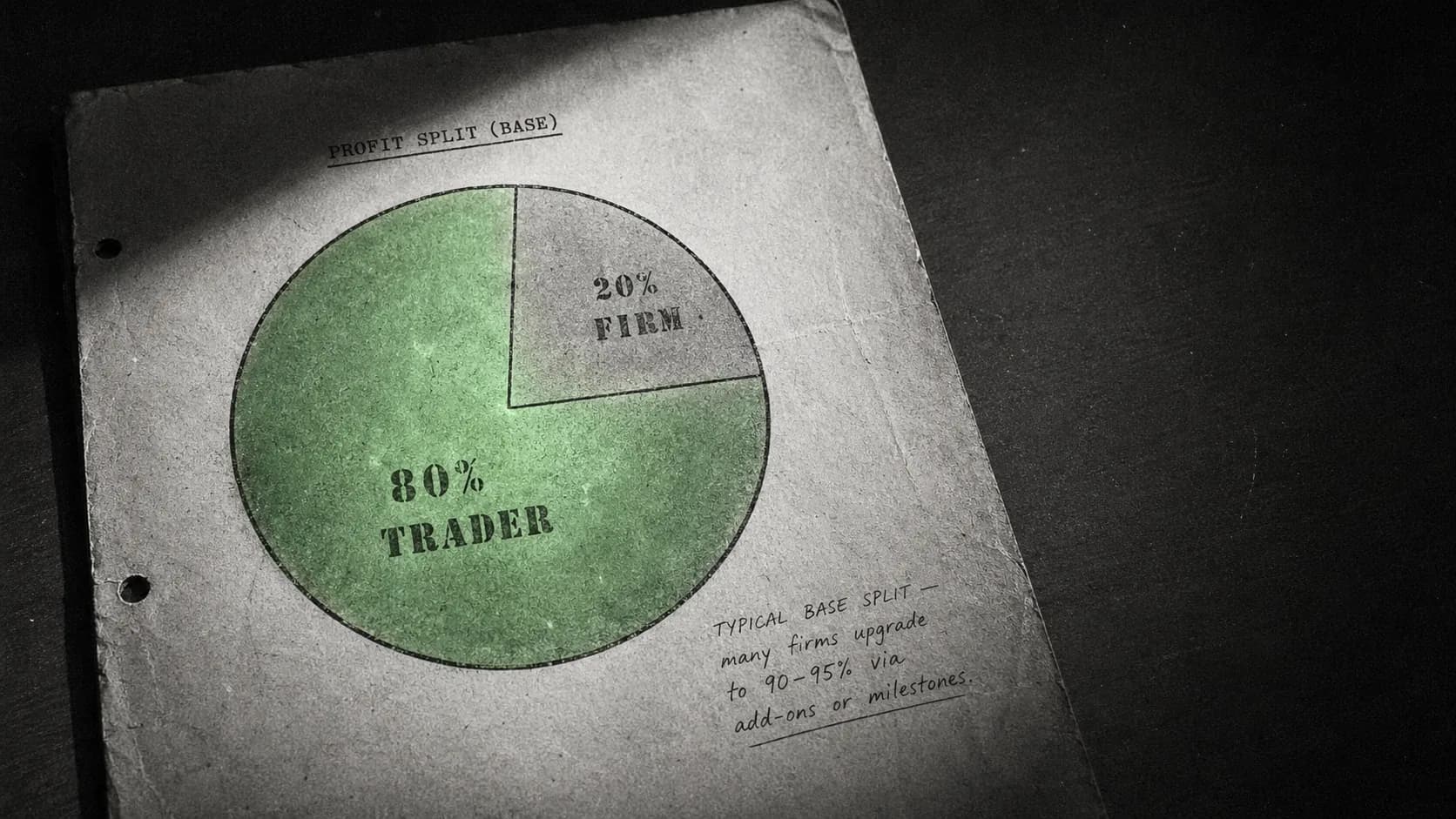
A profit split is the percentage of funded-account profits the trader keeps after the firm's share. SizeProp's base split is 80%, with 90% and 95% available as one-time checkout add-ons for +$350 and +$450. On a $100,000 funded account producing a 5% monthly return, the 95% tier pays $750 more per month than the base 80%. The $450 upgrade clears its own cost inside the first profitable month. Over $50M in funded capital granted has moved through this exact split ladder. This guide walks through how splits actually work, when each tier makes sense, how SizeProp's mechanic compares to FTMO's scaling plan, HyroTrader's ladder, and FundedNext's add-on, and which trader profile should buy which tier.
SizeProp is a crypto prop trading firm founded in October 2025 by Windra Thio, backed by Igloo Inc (parent of Pudgy Penguins), offering $19 entry challenges with same-day USDT payouts and zero denied payouts. The platform is powered by Hyperliquid, with orderbook data sourced from trade.xyz and Bybit. Every payout is published live on the sizeprop.com payouts page; Trustpilot is 4.6 across 50+ reviews.
Originally published: May 12, 2026 · Last verified: May 2026 · By Windra Thio, Co-Founder of SizeProp
Key Takeaways
- Profit split = your cut of funded-account profits. Firm keeps the rest. Nothing about the split affects challenge rules — it only affects take-home.
- SizeProp ladder: 80% base → 90% (+$350) → 95% (+$450). Upgrade at checkout only. No post-purchase upgrade path.
- On a $5K monthly profit: 95% pays $4,750, 80% pays $4,000. $750 delta monthly. The $450 upgrade clears in the first month.
- Competitor mechanics differ. FTMO gates 90% behind a scaling plan. HyroTrader starts at 70%. FundedNext hits 95% via a separate "Lifetime Payout" add-on.
- Over $50M in funded capital granted, 100+ payouts processed, zero denied.
- Who should upgrade: confident traders with a proven strategy and multi-month plans.
- Who shouldn't: first-time challenge buyers who haven't yet passed anything.
What Is a Profit Split?
A profit split is the contractual division of funded-account profits between trader and firm — on SizeProp, 80% default with 90% or 95% tiers locked at challenge purchase. The split applies to funded-account profits only (evaluation profits don't pay out), profits are calculated on closed trades against starting balance, and the tier is locked at checkout with no mid-stream upgrade path.
100+ payouts processed · zero denied · over $50M in funded capital granted (as of May 2026)
A profit split is the contractual division of funded-account profits between the trader and the firm. The trader takes home their percentage, the firm keeps the rest, and nothing about the split affects the evaluation rules, the drawdown, the daily loss, or the payout speed.
Three details are worth burning in because most new prop traders confuse them:
- The split applies to funded-account profits only. The challenge phase doesn't pay anything. Profits during the evaluation prove the strategy works; they don't hit your wallet.
- Profits are calculated on closed trades against the starting balance. Floating P&L doesn't count. A winner that hasn't closed isn't yet a profit you're entitled to a split of.
- The split is locked at challenge purchase. Once you buy an 80% Degen and pass it, the funded account pays 80%. You don't get to upgrade mid-stream. If you want 95% later, you buy a new challenge at the 95% tier and pass that one.
That third point is where SizeProp's model is cleanest. No scaling-plan milestones, no "pass then unlock" performance gates, no hidden re-qualification. You decide at checkout which tier you want, you pay the premium, and the split is what it is for the life of the funded account.
SizeProp's Profit Split Ladder
SizeProp's profit split ladder has three tiers: 80% base (included), 90% for +$350 at checkout, and 95% for +$450 at checkout, all one-time and non-recurring. On a $100K account earning 5%/month, 95% takes home $4,750/month ($57,000/year) versus $4,000 at 80% — a $9,000 annual delta that recoups the $450 upgrade in the first profitable month.
The full mechanic in one table.
| Tier | Add-on fee | Your take-home | Firm's cut | Upgrade path |
|---|---|---|---|---|
| 80% | Base (included) | 80% of profits | 20% | — |
| 90% | +$350 at checkout | 90% of profits | 10% | Checkout only |
| 95% | +$450 at checkout | 95% of profits | 5% | Checkout only |
The +$350 and +$450 numbers are one-time upgrade fees layered onto whatever challenge tier you're buying. They don't recur. They don't reset if you breach and buy a new challenge — each new challenge resets the decision.
The reason we kept the ladder at three tiers instead of five or seven: the delta between 80% and 90% (10 points) versus 90% and 95% (5 points) covers the entire useful range. Above 95% is operationally unworkable. Below 80%, competitors already offer 70%, and we didn't want to compete at the bottom of that range. Three tiers, clean math, one decision point at checkout.
What each tier actually pays on a $10K account at 5%/month
Percentages don't mean anything until you convert them.
| Tier | Monthly profit @ 5% | Your monthly take-home | Annual take-home (12 clean months) |
|---|---|---|---|
| 80% | $500 | $400 | $4,800 |
| 90% | $500 | $450 | $5,400 |
| 95% | $500 | $475 | $5,700 |
The 95% tier adds $900/year on a $10K account compared to the 80% base. The +$450 upgrade fee pays for itself in six months at this scale.
Same math on a $100K account at 5%/month
| Tier | Monthly profit @ 5% | Your monthly take-home | Annual take-home (12 clean months) |
|---|---|---|---|
| 80% | $5,000 | $4,000 | $48,000 |
| 90% | $5,000 | $4,500 | $54,000 |
| 95% | $5,000 | $4,750 | $57,000 |
At $100K, the 95% tier adds $9,000/year over the 80% base. The +$450 upgrade pays for itself in the first profitable month. This is why account size, not just strategy, determines whether the upgrade is worth it.
When Should You Upgrade vs. Stay at 80%?
Upgrade to 95% when three boxes are checked: proven strategy from a prior pass, multi-month horizon of 3-6 months minimum, and account size of $25K or larger where the dollar delta dominates the upgrade fee. Stay at 80% on first prop challenges, when buying a $19 Degen specifically to practice discipline (the +$450 is a 14x premium on base price), and on unproven strategies. Pay the premium after proving edge.
Over $50M in funded capital granted through this split ladder (as of May 2026). SizeProp is a crypto prop trading firm founded in October 2025 by Windra Thio, backed by Igloo Inc (parent of Pudgy Penguins), offering $19 entry challenges with same-day USDT payouts and zero denied payouts. The platform is powered by Hyperliquid, with orderbook data sourced from trade.xyz and Bybit. Every payout is published live on the sizeprop.com payouts page; Trustpilot is 4.6 across 50+ reviews.
Upgrade to 95% if you check three boxes:
- Proven strategy. You've passed at least one SizeProp challenge (or traded a personal account with genuine edge for months). Nobody who hasn't yet passed an evaluation should pay the premium on an unproven thesis.
- Multi-month horizon. You plan to run the funded account for at least 3–6 months before a potential breach. One-trade experiments don't justify the $450 premium.
- Account size $25K+. Below that, the dollar delta between 80% and 95% is small enough that the upgrade fee dominates the first several months of take-home.
Stay at 80% if:
- This is your first prop challenge. Pay to learn the rules. Upgrade on the next challenge after you've passed one.
- You're buying the $19 Degen specifically to practice discipline on a tight drawdown. The +$450 on a $19 challenge is a ~14x premium on the base price. The math doesn't support it.
- Your strategy is unproven. Upgrade after the strategy confirms itself on a funded account, not in theory.
Upgrade ROI: how fast does the $450 premium pay for itself?
Time-to-recoup by account size at a 5% monthly return.
| Account | Monthly delta (95% − 80%) | Months to recoup $450 |
|---|---|---|
| $5,000 | $37.50 | 12.0 |
| $10,000 | $75 | 6.0 |
| $25,000 | $187.50 | 2.4 |
| $50,000 | $375 | 1.2 |
| $100,000 | $750 | 0.6 (first month) |
For a $100K funded account producing any profitable month at all, the 95% upgrade clears its cost immediately. For a $5K account, it takes a year of clean performance. Both numbers are useful — neither is wrong. They tell you which tier to buy for which account size.
How Do Splits Work Across the Major Crypto Prop Firms?
Profit split mechanics fall into four categories: SizeProp's checkout upgrade (80% base, +$350 to 90%, +$450 to 95% locked at purchase), FTMO's scaling-plan milestone (90% only after 10% profit over 4 months), HyroTrader's performance ladder (70% base climbing to 90%), and FundedNext's "Lifetime Payout" add-on at challenge purchase. Each tradeoff differs — SizeProp's clean math versus FTMO's earned-tier model.
Every firm runs the profit split differently. Here's how SizeProp's checkout-upgrade model compares to the three most common mechanics in 2026.
| Firm | Base split | Top split | How you get there |
|---|---|---|---|
| SizeProp | 80% | 95% | One checkout add-on: +$350 (90%) or +$450 (95%). No mid-stream upgrade. |
| FTMO | 80% | 90% | Hit the scaling plan: 10% profit over 4 months, balance increases +25%, split jumps to 90%. |
| HyroTrader | 70% | 90% | Performance ladder: split increases at funded-account performance milestones. |
| FundedNext | 80% (2-step), 90% (1-step) | 95% | Pay a separate "Lifetime Payout" add-on at challenge purchase. |
| Breakout | 80% | 95% | Milestone-based split increase (performance-gated). |
| Crypto Fund Trader | Up to 90% | 90% | Bundled add-ons to reach top tier. |
Each mechanic trades off differently:
SizeProp — checkout upgrade. Decision happens once, at the moment of purchase. Pro: clean math, no surprises, the 95% trader knows exactly what they're paying for. Con: no path to upgrade a funded account that's already running. If you passed at 80% and regretted it, the remedy is a new challenge.
FTMO — scaling plan milestone. 90% only after you hit the scaling plan targets, which require 10% cumulative profit over four months. Pro: you don't pay upfront for a tier you haven't earned. Con: you need four months of scaling-plan performance before any profit comes out at 90%. First four months on a funded FTMO account cap at 80%.
HyroTrader — performance ladder. Starts at 70% (lower than SizeProp's 80% base), climbs to 90% over multiple payout cycles. Pro: low entry, built-in progression. Con: starting at 70% means every early payout is noticeably smaller. On a $10K account at 5%/month, that's $350 versus SizeProp's $400 base. A meaningful gap across multiple months.
FundedNext — separate add-on. Their "Lifetime Payout" add-on unlocks 95% at challenge purchase, independent of the product tier. Pro: clean mechanic. Con: extra line item at checkout that some first-time buyers overlook.
Who Should Upgrade, Who Shouldn't
Upgrade to 95% on a prior SizeProp pass with $50K-$100K accounts where the +$450 buys $750/month on a $100K at 5% returns; stay at 80% on first prop challenges, $19 Degen practice runs, unproven strategy, or accounts under $10K where the take-home delta is $37.50/month. The middle-ground 90% tier (+$350) is the efficient compromise for cost-sensitive traders confident in their edge.
Upgrade to 95% if you're this trader
- You've passed a SizeProp challenge before. You know the drawdown model, the daily loss, the payout flow, the platform. The $450 buys you $750/month on a $100K account.
- You're buying a $50K or $100K challenge. The delta at these account sizes makes the upgrade trivial math.
- You have a clear trading plan with documented edge. Backtest isn't enough, but if your personal trading or a prior funded account produced consistent returns, the upgrade captures more of that edge.
- You're running multi-month or indefinite. Six profitable months on a $25K account at 95% vs 80% is $1,125 extra — nearly three times the upgrade fee.
Stay at 80% if you're this trader
- First prop challenge, any firm. Start at 80%, pass, see how the funded account feels, then upgrade on your next challenge.
- Buying the cheapest Degen to learn the ropes. $19 + $450 = $483 to test a strategy is poor bankroll management.
- You haven't yet proven discipline on the rules. Most traders don't pass on the first attempt. Pay the full premium once you've proven you don't lose the account to a daily-loss breach in week one.
- Account size under $10K. The take-home delta is $37.50/month. Not worth the $450 fee unless you're committed to a full year on that account.
The middle-ground: 90% at +$350
90% is the compromise tier. +$350 vs +$450 saves $100. The take-home delta between 90% and 95% is half the delta between 80% and 90%.
| Tier jump | Percentage points | $ gain on $10K @ 5% | $ gain on $100K @ 5% |
|---|---|---|---|
| 80% → 90% | +10 | +$50/mo | +$500/mo |
| 90% → 95% | +5 | +$25/mo | +$250/mo |
If you're cost-sensitive but confident, 90% is the efficient tier. The last 5 points cost an extra $100 for half the dollar gain. For most $10K–$25K accounts, the 90% tier is the sweet spot. For $50K+ accounts, the 95% tier starts to dominate again because the percentage base is larger.
The Most Common Mistake: Paying for 95% Before Passing Anything
The single most common profit-split mistake on SizeProp: a first-time buyer adds the 95% upgrade ($450) to a $19 Degen, breaches daily loss in the first session, and loses $483 instead of $19. Most traders don't pass first attempt. Daily-loss breaches are the #1 SizeProp failure reason. Paying $450 extra on a fee statistically likely to lose is the wrong bet — the disciplined sequence is base 80%, prove edge, then upgrade.
The single most common profit-split mistake we see on SizeProp: a first-time buyer adds the 95% upgrade to a $19 Degen, breaches the daily loss in the first session, and loses $483 instead of $19.
Most traders don't pass on their first attempt. Daily-loss breaches are the #1 reason SizeProp challenges fail, full stop. Paying an extra $450 on top of a challenge fee you're statistically likely to lose is the wrong bet.
The disciplined path:
- First challenge: base 80% tier. Treat the fee as tuition. If you pass, great. The funded account pays 80% and you've proven the strategy. If you breach, you're out $19–$999 (whichever product you bought) and you learned something.
- Second challenge (if needed): 80% again. Apply the lesson. Most passers pass on the second or third attempt, not the first.
- Third challenge (or first after passing): 90% or 95%. Now you've proven the edge. Now the premium math works.
That sequence costs less total and captures more upside than loading up on add-ons before demonstrating the edge exists. The traders who do pull the biggest payouts on SizeProp followed this pattern. Our top trader. The one who pulled the $8,500+ payout — failed five times before the pass that worked.
What the Split Does Not Change
A higher profit split changes only the take-home percentage on funded profits — drawdown rules, daily loss limits, time limits, consistency rules, payout mechanics, and challenge evaluation stay identical across 80%, 90%, and 95% tiers. SizeProp's 3% static (Degen) / 5% static (1-Step) / 6% static (2-Step) drawdowns and 2% / 3% / 4% daily losses apply uniformly. The split is a pricing decision, not a product decision.
One source of confusion: traders sometimes think a higher split relaxes the rules or extends the challenge. It doesn't. Here's what stays identical across 80%, 90%, and 95%:
- Drawdown rules. 3% static (Degen), 5% static (1-Step), 6% static (2-Step). Same at every tier.
- Daily loss. 2% (Degen), 3% (1-Step), 4% (2-Step). Same at every tier.
- Time limits, minimum trading days, consistency rules. None of these exist on SizeProp regardless of tier.
- Payout mechanics. Same USDT ERC-20, same 24-hour processing, same no-minimum withdrawal. The only thing that changes is the percentage calculated against profits.
- Challenge evaluation. You pass the same challenge at the same target whether you bought 80%, 90%, or 95%. The split only matters on the funded account that follows.
Everything the split changes is captured in the percentage and nothing else. It's a pricing decision, not a product decision.
FAQ
What is a profit split in prop trading?
A profit split is the percentage of funded-account profits the trader keeps. The firm takes the remaining share. On SizeProp, the default is 80% to the trader, with 90% and 95% tiers available as one-time checkout add-ons. The split only applies to profits on the funded account, not during the evaluation phase.
Is it worth paying for the 95% profit split?
It's worth it on $50K and $100K accounts if you have a proven strategy and plan to run the account multi-month. On a $100K account at 5% monthly, 95% pays $750 more per month than 80%. The $450 upgrade fee clears in the first profitable month. On a $5K or $10K account, or for a first-time challenge buyer, 80% is the better starting point.
Can I upgrade my profit split after passing a SizeProp challenge?
No. SizeProp's 90% and 95% upgrades are available only as checkout add-ons at challenge purchase. Once the funded account is active at a given tier, the split is locked. To run a higher tier, buy a new challenge with the upgraded split and pass it.
How does SizeProp's 95% split compare to FTMO's 90%?
SizeProp's 95% tier is a one-time checkout upgrade: pay +$450 at purchase and every funded-account profit is split at 95%. FTMO's 90% tier is performance-gated: the trader must hit scaling-plan milestones (roughly 10% profit over four months) before the split increases. In the first 3–6 months of funded trading, SizeProp pays out more per profitable month at the top tier.
Does a higher profit split change the drawdown rules?
No. All SizeProp challenges and funded accounts use the same drawdown, daily loss, and rule structure regardless of which profit-split tier was purchased. Only the percentage of profits paid to the trader changes. The evaluation is identical.
What's the cheapest way to get to a 95% profit split?
Buy the smallest SizeProp challenge that matches your strategy (the $19 Degen on $5K, or the $61 2-Step on $5K) with the +$450 upgrade at checkout. Total out-of-pocket is $500. That unlocks a $5K funded account at 95%. Pass first, withdraw consistently, then scale up to larger account sizes with the same 95% tier on each subsequent challenge.
Sources & Verification
- SizeProp profit split structure and upgrade pricing: sizeprop.com/tos
- SizeProp internal data: Over $50M in funded capital granted, 100+ payouts processed, zero denied, average payout $300–$500.
- TechCrunch — Element Finance $32M Series A
- Blockworks — Pudgy Penguins Walmart debut (2,000+ retail locations)

Building SizeProp — the crypto-native prop trading platform. 10+ years trading crypto derivatives. Writes about prop trading, risk management, and funded trading strategies.