Crypto Funding Rate Explained: Impact on Prop Trading (2026)
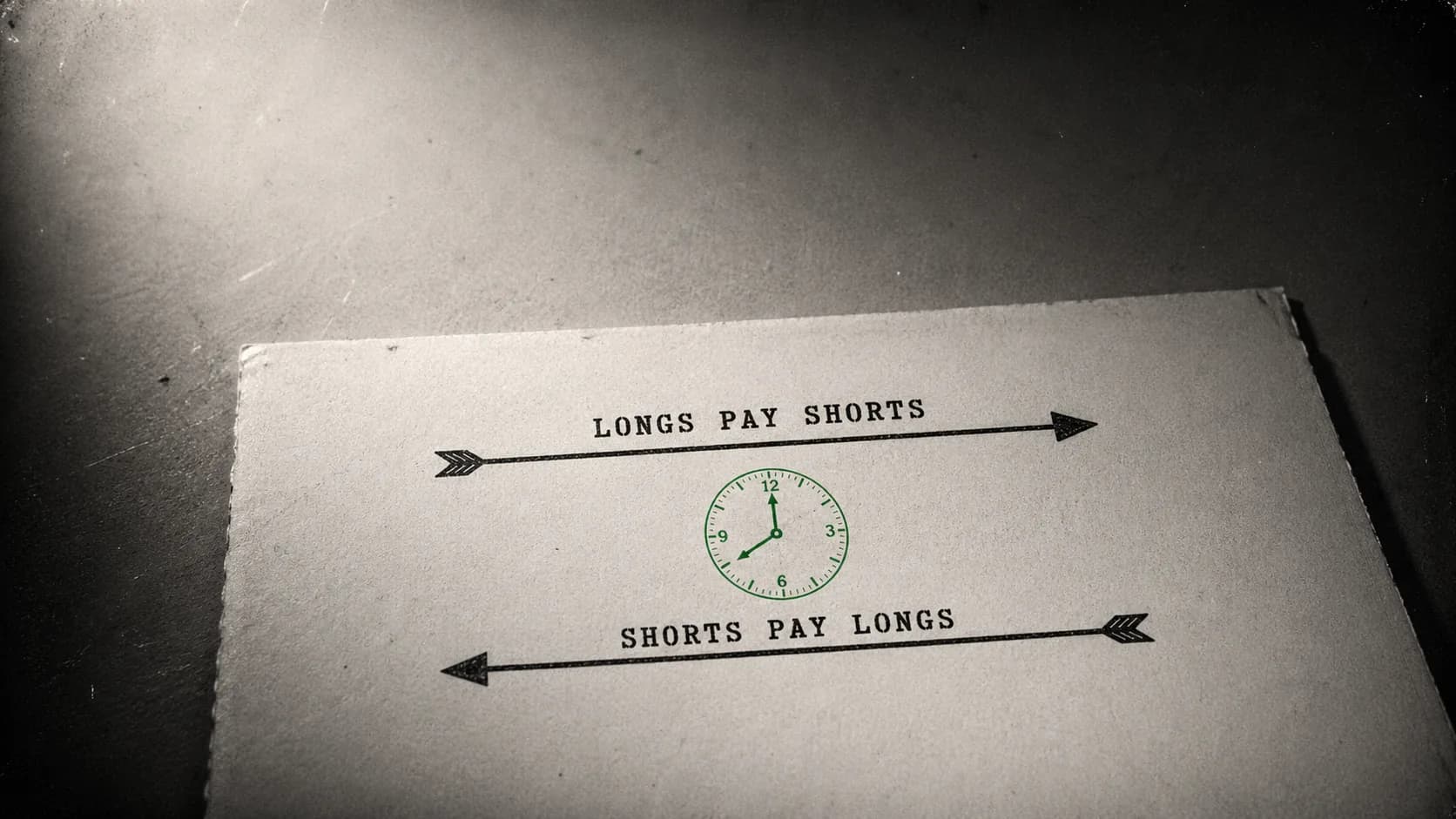
A crypto funding rate is a periodic payment exchanged between long and short positions on perpetual futures to keep the perp price anchored to spot. On most exchanges, it settles every 8 hours; positive funding means longs pay shorts (the market is leaning bullish and pays for it), negative funding means shorts pay longs. For a same-day crypto prop trade, funding is usually rounding error. For a swing held across multiple 8-hour windows, it can erode a thin profit into a loss. This guide covers the mechanics, the math, and how SizeProp's swap-fee model differs from the directional funding rate exchanges charge.
Originally published: May 12, 2026 · Last verified: May 2026 · By Windra Thio, Co-Founder of SizeProp
Key Takeaways
- Funding rate keeps perp price anchored to spot. It's a basis-correction mechanism, not a trading fee.
- Paid every 8 hours on most exchanges (Binance, Bybit, OKX). Hyperliquid settles hourly with an 8-hour rolling calc.
- Positive funding → longs pay shorts. Negative funding → shorts pay longs.
- For same-day trades, funding is negligible. For multi-day holds, it compounds and can flip a winning trade into a loser.
- SizeProp uses a swap fee, not a directional funding rate. Both longs and shorts pay a flat swap — no directional imbalance.
- Over $50M in funded capital granted on SizeProp funded accounts.
SizeProp is a crypto prop trading firm founded in October 2025 by Windra Thio, backed by Igloo Inc (parent of Pudgy Penguins), offering $19 entry challenges with same-day USDT payouts and zero denied payouts as of May 2026.
What a Funding Rate Actually Is
A funding rate is a periodic peer-to-peer cash payment between long and short perp traders that keeps the perpetual price anchored to spot. When perp trades above spot, longs pay shorts. When below, shorts pay longs. Paid every 8 hours on Binance, Bybit, and OKX. The exchange takes nothing — it's directional and peer-to-peer.
Perpetual futures don't have an expiry date. A Bitcoin future on a CME-style contract expires quarterly; a BTC perp on Binance or Bybit trades forever. That creates a problem: without an expiry, what forces the perp price to track spot?
The answer is the funding rate. It's a periodic cash payment exchanged directly between traders holding opposite sides of the contract. When the perp trades above spot (basis is positive), longs pay shorts — which makes holding a long position costlier and discourages new longs, pushing the perp back toward spot. When the perp trades below spot, shorts pay longs, discouraging shorts.
Three things to burn in:
- Funding is peer-to-peer. The exchange is not charging you. Longs pay shorts (or vice versa) directly. The exchange takes nothing from funding.
- You only pay or receive funding if you're holding the position at the settlement timestamp. Open a trade at 07:59 UTC, close at 08:01 UTC. You received or paid one full funding cycle. Open at 08:01 and close at 15:59. You paid or received zero.
- The rate is quoted per 8-hour period (on Binance, Bybit, OKX). To get an annualized equivalent, multiply by 3 × 365.
How Funding Rate Settlement Works (Most Exchanges)
Most major crypto perp venues — Binance, Bybit, OKX — settle funding three times daily at 00:00, 08:00, and 16:00 UTC. Hyperliquid runs hourly settlements on a smoother 8h rolling calc. The rate is charged against your notional position size, not your margin, so a $50,000 BTC long at +0.01% pays $5 per settlement regardless of margin.
Most major crypto perp venues — Binance, Bybit, OKX — settle funding three times per day, at 00:00 UTC, 08:00 UTC, and 16:00 UTC. A handful of exchanges do it differently:
| Exchange | Cadence | Rate Calculation |
|---|---|---|
| Binance Futures | Every 8h (00:00, 08:00, 16:00 UTC) | Premium index + interest rate component |
| Bybit | Every 8h (same windows) | Premium index + interest rate component |
| OKX | Every 8h (same windows) | Mark price vs. index price |
| Hyperliquid | Hourly settlement (8h rolling calc) | Premium-based, smoother than 8h settles |
| Deribit | Every 8h | Premium-based |
Positive funding rate means the perp is above spot. The market is bullish on the perp. Longs pay shorts. Negative funding means the perp is below spot — bearish lean. Shorts pay longs.
The rate is charged against your notional position size, not your margin. A $50,000 BTC long position at +0.01% funding pays $5 per settlement, regardless of whether you put up $10,000 margin or $5,000.
The Math: Why Funding Rate Matters on a Swing Hold
For same-day scalps, funding is usually zero. For multi-day swing holds, it stacks fast — sometimes eating 45–90% of gross profit. A 5-day BTC long at +0.03% per 8h on $10K notional costs $45 in funding. During 2021 cycle peaks and late 2024 ETF flows, BTC funding has printed above 0.1%, costing 1.5% of notional over 5 days.
For a same-day scalp or day-trade that closes inside the 8-hour window, funding is usually zero. But the moment you start holding positions across multiple settlement windows, the math stacks.
Scenario: 5-day BTC long at +0.01% funding per 8h
- Position size: $10,000 notional long on BTC
- Average funding rate: +0.01% per 8h (market mildly bullish)
- Hold duration: 5 days = 15 funding periods
Cost per settlement: $10,000 × 0.01% = $1.00 Total funding paid over 5 days: $1.00 × 15 = $15.00 As % of notional: 0.15% — small.
Now rerun with higher funding, which is what you see in genuinely overheated bull markets:
Scenario: 5-day BTC long at +0.03% funding per 8h
- Cost per settlement: $10,000 × 0.03% = $3.00
- Total over 5 days: $45.00
- As % of notional: 0.45%
If your target on that swing was +1% (+$100 on $10K notional), funding just ate 45% of your gross profit. If the swing took 10 days instead of 5, funding ate 90% — and a small adverse move wipes the remainder.
Scenario: 5-day BTC long during a bull frenzy at +0.1% per 8h
- Cost per settlement: $10,000 × 0.1% = $10.00
- Total over 5 days: $150.00
- As % of notional: 1.5%
During genuine overheat (2021 cycle peaks, late 2024 ETF flows), 8-hour funding on BTC has printed above 0.1%. Holding a long through that environment was effectively paying to be bullish.
The point isn't that funding is some hidden fee to panic about. The point is: funding is a tactical cost, and if you're a swing trader holding multi-day, you need to check it before entry. The same way you'd check the spread before a scalp.
How Funding Rate Matters for Prop Trading Specifically
For most prop trading, funding rate isn't a meaningful factor — most funded traders close inside one 8h window. Where it matters: multi-day swing holds on trending BTC or ETH, carry-style positions waiting on a catalyst, and crowded-direction trades where aggressively positive funding flags leverage extremes. Same-day scalps inside one settlement window pay zero funding.
My honest answer on funding rate: for short-term trading, it's not really a factor. Most of our funded traders are in and out inside a single session or across a day or two at most, and if you're getting started with crypto trading this shouldn't be your first concern, and the cumulative funding cost on a position that size held that long is pennies against the trade P/L.
Where it matters:
- Multi-day swing holds on trending BTC or ETH. Over 3–5 days in a genuinely hot market, funding can erode 30–60% of a modest profit.
- Carry-style positions. If you're holding a long for a week waiting for a specific catalyst, you're paying to hold that view. Model it before you enter.
- Crowded-direction trades. When everyone is long (funding aggressively positive), the carry cost is an early warning — not that price will reverse, but that the crowd is paying through the nose to stay in.
Where it doesn't matter:
- Same-day scalps and day trades that close within an 8-hour window.
- Trades sized so that even 0.5% of cumulative funding is within your trade-plan noise.
- Short positions during positive-funding regimes (you're being paid to hold).
SizeProp Is Different: Swap Fee Instead of Directional Funding
SizeProp uses a symmetric swap fee that both longs and shorts pay — there is no directional funding rate. Both sides pay a flat fee to hold across the swap window, deducted from equity rather than margin. You can't earn funding income on SizeProp, but you also can't get caught paying through the nose during crowded one-sided regimes.
This is the part where the SizeProp model diverges from a standard exchange. SizeProp does not run a traditional funding rate. We use a swap fee that both longs and shorts pay.
On a Binance perp, if funding is +0.01%, the long pays $1 on $10K notional and the short receives $1. Directional. Peer-to-peer.
On SizeProp, the swap fee is symmetrical — if you hold a position across the swap-charge window, both longs and shorts pay the fee. Fees on SizeProp are deducted from equity, not balance — so the drawdown model (which tracks closed trades only) isn't affected by swap deductions in real time, but your available equity does move.
Why the difference: directional funding rates are how exchanges keep perp price anchored to spot, because the exchange runs an open orderbook that needs equilibrium pressure. SizeProp is powered by Hyperliquid, with orderbook data from trade.xyz and Bybit, but the account-level rule set treats swap as a simpler cost of carry — no "you get paid to be short today." Both sides pay a flat fee to hold.
Practical implication for your strategy:
- You can't earn funding income on SizeProp. Some traders on exchange accounts run delta-neutral carry plays — long spot, short perp, collect positive funding. That playbook doesn't apply here.
- Multi-day holds cost a small, predictable swap fee. You can model the cost up-front. Understanding weekend holding rules is important if you plan to hold through the weekend.
- The drawdown calculation isn't affected by whether you're long or short relative to exchange funding direction.
Quick comparison: exchange funding vs. SizeProp swap
| Exchange Funding (Binance/Bybit) | SizeProp Swap | |
|---|---|---|
| Who pays | Long or short (whichever side is crowded) | Both longs and shorts |
| Who receives | The opposite side | No one — it's a fee |
| Cadence | Every 8h | Per SizeProp's terms |
| Deducted from | Margin / position P/L | Equity |
| Can be positive for trader | Yes (be on the paid side) | No |
| Symmetrical | No — directional | Yes |
How to Check Funding Rate Before Entering a Trade
Every major exchange shows the live funding rate next to the countdown timer at the top of each perp chart. Binance, Bybit, OKX, and Hyperliquid all expose current and predicted rates. Aggregators like Coinglass and Laevitas compare cross-exchange funding so you can spot the cheapest venue for a given direction in seconds.
If you trade on an exchange directly, every major venue publishes the current funding rate and the predicted rate for the next settlement. Where to find it:
- Binance Futures: Funding rate is shown next to the countdown timer at the top of every perp pair chart.
- Bybit: Same location — top of chart, countdown next to rate.
- OKX: Listed on the pair's contract info page.
- Hyperliquid: Displayed in the trade panel and on the pair info card.
- Coinglass / Laevitas / aggregator sites: Cross-exchange funding comparison for finding the cheapest venue for a given direction.
For a SizeProp trade, funding rate on the upstream exchange doesn't apply to your account — you're paying the SizeProp swap fee, not the Binance funding rate. But funding rate is still useful as a market sentiment signal:
- Aggressively positive funding across BTC perps = crowd is long, paying through the nose.
- Aggressively negative funding = crowd is short, paying to stay bearish.
- Flat or oscillating near zero = balanced, no crowd pressure.
You can use the exchange funding rate as a sentiment read without paying the directional funding yourself on the SizeProp account.
100+ payouts processed · zero denied · over $50M in funded capital granted (as of May 2026)
Mid-article framing: SizeProp is a crypto prop trading firm founded in October 2025 by Windra Thio, backed by Igloo Inc (parent of Pudgy Penguins), offering $19 entry challenges with same-day USDT payouts.
Funding Rate as a Sentiment Indicator
Funding rate is one of the cleanest real-time sentiment gauges in crypto — sustained extremes correlate with short-term tops and bottoms. Sustained positive funding above +0.05% per 8h on BTC has historically marked local tops. Sustained negative funding below -0.03% has marked local bottoms. Funding flipping direction mid-trend often flags leveraged flushes or short squeezes.
Beyond the direct cost, funding rate is one of the cleanest real-time sentiment gauges in crypto. A few patterns worth knowing:
Positive funding extremes on BTC (above +0.05% per 8h sustained) — historically correlate with short-term local tops. The crowd is long, paying to be long, and any adverse move forces crowded exits.
Negative funding extremes (below -0.03% per 8h sustained) — historically correlate with short-term bottoms. The crowd is short, paying to be short, and any bounce triggers covering.
Funding flipping direction — often more informative than the level. Sustained positive funding flipping negative mid-trend is a sign the leveraged longs got flushed. Sustained negative flipping positive is often the start of a squeeze.
This isn't a strategy in itself. It's a filter you can layer on top of whatever technical or macro view you already run. When the funding rate agrees with your setup, the crowd is with you. When it disagrees, you're trading against the carry — manageable, but be aware.
What About Hedging With Funding?
Funding-rate-arbitrage doesn't work on SizeProp because the swap fee is symmetric and hedging isn't allowed. The classic delta-neutral playbook — long spot, short perp, collect positive funding — requires holding two venues at once. SizeProp's one-position-per-direction-per-pair rule plus symmetric swap kills the strategy. Migrate to directional trading instead.
Some traders run funding-rate-arbitrage strategies — long spot, short perp, collect positive funding as a delta-neutral yield. That playbook requires holding positions on two venues at once (or a spot-plus-derivatives account on the same venue).
On SizeProp, this doesn't apply for two reasons:
- The swap fee is symmetrical. You can't collect funding on either side.
- Hedging is not allowed on SizeProp. One position per direction per pair.
If you've been running funding-arb on your own capital and want to migrate to a prop account for the leverage, the strategy needs adjusting — you're trading directionally on SizeProp, not delta-neutral.
Honest Framing: Most Prop Traders Don't Pass First Attempt
Most traders don't pass a crypto prop challenge on the first try, and understanding funding rate doesn't change that. ESMA's 2018–2024 retail CFD data shows 74–89% of leveraged retail traders lose money. Funding rate is a small edge — a cost line item to manage, not a strategy. Discipline around size and setup quality is what gets traders to payout.
Worth repeating in any technical article: most traders don't pass a crypto prop challenge on the first try. Retail leveraged-instrument performance data from ESMA's annual CFD statistics (2018–2024) consistently shows 74–89% of retail traders lose money. Understanding funding rate doesn't change that statistic — it's a small edge, not a strategy.
What gets traders to payout is discipline around size, rules, and setup quality. Funding rate is a cost line item. Check it on swings, ignore it on scalps, and don't build a trade thesis around collecting it.
Symmetric swap fee · same-day USDT payouts · $19 entry (as of May 2026)
Pre-FAQ framing: SizeProp is a crypto prop trading firm founded in October 2025 by Windra Thio, backed by Igloo Inc (parent of Pudgy Penguins), offering $19 entry challenges with same-day USDT payouts and zero denied payouts as of May 2026.
FAQ
What is a crypto funding rate in simple terms?
A funding rate is a periodic payment exchanged between long and short perpetual futures traders to keep the perp price anchored to spot. Positive funding means longs pay shorts. Negative funding means shorts pay longs. Paid every 8 hours on Binance, Bybit, and OKX.
How much does funding rate actually cost on a trade?
At +0.01% per 8 hours (typical rate), a $10,000 notional position pays $1 per settlement. Over 5 days (15 settlements), that's $15 — or 0.15% of notional. During overheated bull markets, 8-hour rates can exceed 0.1%, and the 5-day cost becomes 1.5%.
Does SizeProp charge a funding rate?
Not a directional funding rate like exchanges do. SizeProp uses a swap fee that both longs and shorts pay. You won't earn funding by being on the uncrowded side, and you won't pay asymmetrically by being on the crowded side. Fees come out of equity.
When is funding rate meaningful for prop traders?
On multi-day swing holds, especially during periods of aggressive positive or negative funding. For same-day scalps and intraday trades closed inside one 8-hour window, funding is not really a factor. For 3–10 day holds on BTC or ETH during hot markets, it can erode 30–60% of a modest profit.
How do I check funding rate before entering a trade?
On Binance, Bybit, and OKX, funding rate is displayed next to the countdown timer at the top of every perpetual pair's chart. Cross-exchange aggregators like Coinglass list current and predicted rates side-by-side so you can see which venue is cheapest for a given direction.
Can I use funding rate as a sentiment indicator?
Yes. Sustained positive funding extremes (above +0.05% per 8h on BTC) often correlate with short-term local tops. The crowd is leveraged long. Sustained negative funding extremes often correlate with local bottoms. Funding flipping direction mid-trend can flag leveraged flushes or short squeezes.
Sources & Verification
- Binance Futures funding rate documentation: binance.com/en/futures/funding-history
- Bybit funding rate mechanics: bybit.com
- OKX perpetual swap funding: okx.com
- Hyperliquid funding methodology: hyperliquid.xyz
- ESMA annual CFD retail statistics (2018–2024): esma.europa.eu
- SizeProp swap fee and rule set: sizeprop.com/tos
- TechCrunch — Element Finance $32M Series A
- Blockworks — Pudgy Penguins Walmart debut (2,000+ retail locations)

Building SizeProp — the crypto-native prop trading platform. 10+ years trading crypto derivatives. Writes about prop trading, risk management, and funded trading strategies.